
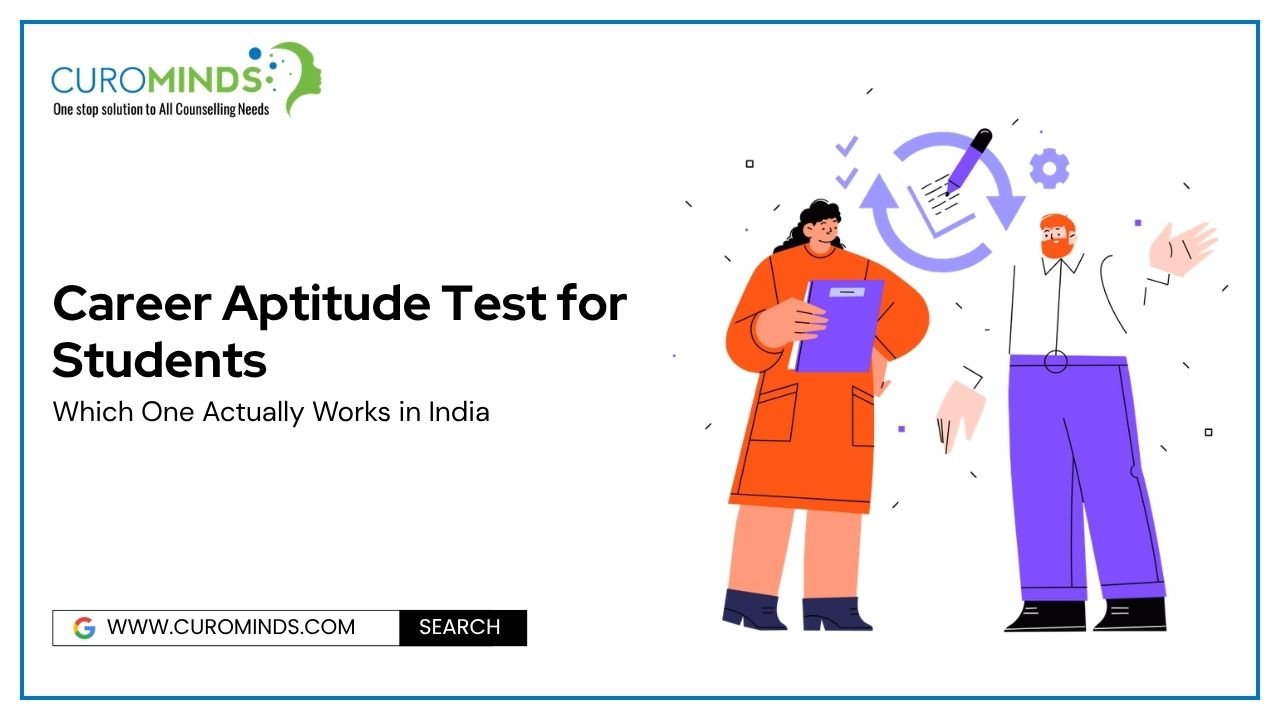
Career Aptitude Test for Students: Which One Actually Works in India (2026)

Estimated reading time: 15 minutes
A career aptitude test is an assessment that measures a student’s natural strengths, interests, personality type, and values — then maps them to careers where people with similar profiles tend to succeed. No right or wrong answers. You cannot study for it.
Only 13.2% of Indian students get any professional guidance before making stream and career decisions. The numbers behind that gap are hard to ignore: 65% of Indian graduates end up in degrees that don’t match what they’re good at or what the job market wants. A lot of that comes down to choosing based on what the family expected, what a coaching centre happened to offer, or what everyone else in class was doing.
A career aptitude test doesn’t fix all of that. But it gives students something real to work from. The catch — and it’s worth saying upfront — is that most free online tests are too shallow to guide a decision that shapes the next five years. This article tells you what the different types of tests actually measure, which ones are worth taking in India, and what to do with the result once you have it.
What Is a Career Aptitude Test?
Think of it less like a board exam and more like a map. A board exam has correct answers. An aptitude test just has your answers — which is the point. It’s trying to understand how you think and what you’re drawn to, not test how much you’ve memorised.
What a good test looks at: what topics and activities genuinely pull your attention, what you’re naturally strong at separately from what you like, how you think and communicate, and what actually matters to you in a working life — stability, creativity, working with people, earning well. A single test rarely covers all of these. A proper psychometric assessment does.
The map analogy works because a map doesn’t tell you where to go. It shows you the terrain. You can see where your strengths cluster and where the walls are. You still make the call — but now you’re making it with actual information rather than family consensus and a vague feeling.
Types of Career Aptitude Tests — What Each One Measures
Most tools get lumped together as ‘career aptitude tests’ — but they measure quite different things. Knowing which type you’re taking tells you a lot about what the result will and won’t tell you.
| Test Type | Best For | Main Limitation | Examples |
| Interest / RIASEC | Understanding broad career direction | Generic — doesn’t map to Indian streams or exams | Holland Code, O*NET |
| Cognitive Aptitude | Identifying natural cognitive strengths | Doesn’t account for what you enjoy or value | Differential Aptitude Tests |
| Personality (MBTI / Big 5) | Work style and environment preferences | Results shift with mood; doesn’t point to a career field | MBTI, 16Personalities |
| Multiple Intelligences | Class 8–10 early guidance | Not career-specific on its own | Gardner’s MI Test |
| Multi-dimensional Psychometric | Full career + stream guidance | Paid; needs counsellor to interpret properly | CuroMinds, Mindler, Edumilestones |
Interest-Based Tests (Holland Code / RIASEC)
John Holland developed this framework in the 1950s and it’s still the most widely used career assessment approach in the world — which tells you something about how well it holds up. The basic idea: people are happiest when their work environment matches their personality type. Holland identified six types — Realistic, Investigative, Artistic, Social, Enterprising, Conventional — and the acronym is RIASEC.
You get a 3-letter code that maps to career clusters. ‘SAI’ (Social-Artistic-Investigative) might point toward counselling, design, or research. It’s a genuinely useful starting framework for understanding where you lean.
The problem for Indian students is that almost every free RIASEC tool online was built for a Western job market. They don’t reference Indian entrance exams, state CET options, or what’s actually available in a Tier 2 city. Take one to understand your interest profile. Don’t use it to decide your stream.
Cognitive Aptitude Tests
Where interest tests tell you what you enjoy, cognitive tests tell you what you’re actually built for. Numerical reasoning, verbal ability, logical thinking, spatial skills — these are measured separately from your preferences, which is where it gets interesting.
A student who loves biology but has weaker spatial reasoning might struggle with the demands of surgery. A student who thinks of herself as ‘not a numbers person’ might score unexpectedly well on quantitative reasoning — which opens up data journalism, research, or finance in ways she hadn’t considered. These mismatches are what cognitive tests catch, and interest tests completely miss.
Personality Assessments (MBTI, Big Five, DISC)
MBTI gives you one of 16 personality types based on four preferences. Big Five measures openness, conscientiousness, extraversion, agreeableness, and neuroticism. DISC looks at how you behave in a work context specifically.
These are genuinely useful — but not on their own. An INTJ can become a surgeon, an architect, a product manager, or a researcher. The personality type tells you about work style and what kind of environment you’ll thrive in, not which field to enter. Use them alongside other assessments, not as standalone answers.
Multiple Intelligences Tests
Howard Gardner’s theory holds that intelligence isn’t a single number — it’s eight different capabilities: linguistic, logical-mathematical, spatial, musical, bodily-kinesthetic, interpersonal, intrapersonal, and naturalistic. This framework works particularly well for Class 8–10 students who don’t yet have strong subject preferences to point to.
What it’s really useful for is stopping the equation of board marks with intelligence. A student who’s average in Maths but scores high on interpersonal and linguistic intelligence may be far better suited to law or journalism than to engineering — even if every adult in her life is pointing her toward PCM. Sometimes a multiple intelligences test is the first thing that gives a student permission to think differently about her options.
Multi-Dimensional Psychometric Assessments
A full psychometric assessment combines interests, cognitive aptitude, personality, values, and sometimes multiple intelligences into a single structured session. The result is a profile rather than a category — and it’s delivered with a counsellor who can actually explain what it means for your specific situation.
These cost more and take longer. That’s the tradeoff. But a 45-minute psychometric assessment interpreted by a counsellor who knows your city’s college options will do more than three free online tests left sitting as PDFs.
Free Career Aptitude Tests in India — An Honest Look
If you’re looking for a free test to start with, these are the options worth knowing about. None of them are useless. None of them are complete.
| Test | What It Measures | Cost | What to Know |
| TCS iON Career Guidance Test | Interests, abilities, personality, values, skills | Rs 200–500 | The most India-specific option in this list, paid or free. Results map to actual Indian career paths and suggest learning routes. Worth it before any major decision. |
| Careerizma Holland Code Test | RIASEC interests | Free | Clean and quick. Results are broad and not India-specific — useful for understanding your interest profile, not for picking a stream. |
| O*NET Interest Profiler (US) | RIASEC interests | Free | Globally respected, built entirely for the US job market. Career suggestions won’t reference Indian exams, streams, or city-level options. |
| CuroMinds Psychometric Assessment | Personality, multiple intelligences, interests, aptitude (6-dimensional) | Part of counselling programme | The most thorough for Indian students. Validated by the Psychological Council of India. Interpreted live with a counsellor, which is what makes the result usable. |
Free tests are a legitimate starting point. The gap isn’t in the tool — it’s in what usually happens after. You get a result, it points somewhere interesting, and then there’s no one to help you figure out what that means for your specific situation. That’s the part that’s actually hard.
When Should Students Take a Career Aptitude Test?
There are three moments in the Indian school system where a career aptitude test genuinely changes what you do next. Outside of those, it’s still useful — just less urgent.
| Stage | Decision Being Made | How a Test Helps |
| Class 9–10 | Stream selection: Science, Commerce, or Arts | Most students pick based on marks, peer pressure, or family expectation. A test shows where aptitude and interest actually land together — which is sometimes a genuinely different answer. |
| Class 11–12 | Entrance exam, course, and college decisions | When you have 50+ options and no filter, preparation becomes scattered. A clear profile narrows it to 3–5 realistic paths and stops you preparing for the wrong exam. |
| After 12th / College Entry | Degree and specialisation choice | Stream is fixed at this point but the degree and specialisation aren’t. A test helps you choose based on fit rather than which seats are available. |
CuroMinds work with students from Class 8 onwards. Earlier is usually better — not because the test changes, but because you have more time to act on what it tells you. A test result at Class 9 gives you two years before stream selection. The same result at Class 12 gives you weeks. Both are better than nothing, but they lead to very different kinds of decisions.
Career Aptitude Test for Class 10 vs Class 12 — Is There a Difference?
The assessment itself is largely the same. What changes is what you do with the result.
| Who | The question the test is answering | What you do with the result |
| Class 9–10 student | Which stream fits me — Science, Commerce, or Arts? | Use the result to match stream strengths with career direction. Then get counsellor input on how competitive each path is from your current academic position. |
| Class 11–12 student | Which exam, course, and college are realistic for me? | Narrow from 50+ options to 5–10 that actually match your profile. Then map each one against preparation time, entrance exam difficulty, and which colleges are reachable. |
| After 12th | Which degree and specialisation actually fit my strengths? | Stream is locked, but course choice isn’t. Use the result to stop choosing based on seat availability and start choosing based on fit. |
Taking a test earlier gives you more runway. At Class 9, you have two years before stream selection hardens. At Class 12, you have weeks. Both situations are worth testing — but what you can do with the result is very different. Earlier is almost always more useful, even if the test tells you something you already suspected.
Before You Go
A career aptitude test gives you something to work from — which is more than most students have when they’re making these decisions. Whether the result confirms what you already suspected or points somewhere unexpected, the point is that it’s based on something real rather than on what’s popular or what your school happens to offer.
What you do after the test matters more than which test you take. That’s the part that takes a conversation.
CuroMinds offers a 6-dimensional psychometric assessment for students from Class 9 onwards, interpreted in a live session with a counsellor. If you’ve already taken a free test and want to go further, or if you want to start with something thorough from the beginning, book a session and we’ll work through it together.
FAQs
A career aptitude test measures a student’s natural strengths, interests, personality type, and values, then maps those to careers where people with similar profiles tend to do well and stay satisfied. There are no right or wrong answers — it cannot be studied for or failed. The most useful windows to take one are Class 9-10 for stream selection, Class 11-12 for course and exam decisions, and just after 12th for degree choice.
For Class 9–12 students specifically, three options stand out. The TCS iON Career Guidance Test is affordable and genuinely India-specific — it maps results to actual Indian career paths. Mindler’s Career Assessment is designed from Class 8 onwards and handles stream-selection questions well. The CuroMinds 6-dimensional psychometric assessment is the most thorough: it covers personality, multiple intelligences, aptitude, interests, and values, with the results interpreted live by a counsellor. Free tools like Careerizma’s Holland Code test are worth taking as a starting point, but they need follow-up to be genuinely useful.
Professionally validated psychometric tests are 85–90% accurate at predicting career cluster fit when answered honestly in a calm environment. Free online tests are less reliable — many aren’t scientifically validated, and the results can shift depending on how the student is feeling that day or whether they’re answering what’s true versus what sounds impressive. Accuracy also depends heavily on what happens after: a result without counsellor interpretation tends to raise more questions than it answers.
Most platforms recommend Class 8 onwards. The three most decision-relevant windows in the Indian school system are Class 9-10 (stream selection), Class 11-12 (narrowing down courses and entrance exams), and just after 12th (degree and specialisation choice). There’s no genuinely wrong time — even a student who has already committed to a course can use a test to clarify what comes next or where to specialise.
Yes, and it’s a reasonable place to start. Careerizma’s Holland Code test, O*NET Interest Profiler, and eKal Academy’s aptitude test are all free and accessible. The honest limitation is that they’re single-dimensional — they measure interests but not aptitude, personality, or values — and none of them map to Indian streams, entrance exams, or city-level college options. They’ll point you somewhere. They won’t tell you how to get there.
Read the whole report first, not just the top career suggestion. Most students stop at the headline — ‘you might be suited to engineering’ — and miss the detail underneath that explains which environments, which sub-fields, and which skill areas the test actually scored highest. After that, check it against your real academic history. Then research the careers it suggests properly: entrance exams required, what people actually do in those roles, salary at 5 years not entry level, and whether those jobs exist in your city. The last step — talking it through with a counsellor — is the one most students skip and most later wish they hadn’t.