Estimated reading time: 14 minutes
Most students searching for finance courses in India already know they want a career in finance. What they don’t know is which course actually makes sense for their situation. There are too many options, too many people selling you on one path, and not enough honest comparison. So here it is.
Finance courses in India range from a 3-month NISM certification to a 5-year CA program. The right one depends on where you are now, what kind of work you want to do, and how much time and money you can put in.
Finance covers a wide range of work: accounting, investment, banking, risk, taxation, financial planning. The courses preparing you for these roles are just as varied.
You probably should look at finance courses if you finished Class 12 from commerce and aren’t sure what to do beyond B.Com. Or you’re in your final year of graduation and want something that helps with placement. Or you’re already working and the person above you has a CFA or CMA and you’re wondering if you need one too.
Science and arts students ask whether they can get into finance without a commerce background. The answer is yes, though some courses have math requirements. B.Com, BBA Finance, and most certifications are open to all streams.
India’s BFSI sector employed over 6 million people in 2024 and accounts for roughly 36% of the NSE’s market cap, according to IBEF. Banking, mutual funds, and fintech are all hiring. But the roles and the courses that prepare you for them are different. Don’t just pick finance broadly. Pick the specific job you want, then work backwards.
If you’ve just cleared your boards, the decision is simpler than it looks. For most students, B.Com combined with a professional certification started early is the strongest path. CA Foundation can be started right after Class 12. CFA Level 1 can be started in the final year of graduation.
| Course | Duration | Fees (Approx.) | Starting Salary |
| B.Com in Finance | 3 years | Rs. 20,000 – Rs. 2 LPA | Rs. 3 – 5 LPA |
| BBA in Finance | 3 years | Rs. 50,000 – Rs. 3 LPA | Rs. 3.5 – 6 LPA |
| CA Foundation | 4-5 years total | Rs. 15,000 – Rs. 1 LPA | Rs. 7 – 15 LPA (post-CA) |
| Diploma in Banking & Finance | 1 year | Rs. 20,000 – Rs. 80,000 | Rs. 2.5 – 4 LPA |
| CS (Company Secretary) | 4-5 years | Rs. 20,000 – Rs. 60,000 | Rs. 3.6 – 8 LPA |
| NSE Capital Market Course | 3-6 months | Rs. 5,000 – Rs. 20,000 | Rs. 2.5 – 4 LPA |
Here’s a realistic example. A student from Jaipur doing B.Com at a state university pays under Rs. 30,000 for the entire degree. She starts CA Foundation in the first year and clears it by her second. By the time she graduates, she has two years of CA Intermediate cleared. That’s a stronger CV than someone who paid Rs. 8 lakh for a BBA at a private college and did nothing else.
After your bachelor’s degree, the options get more expensive and more globally valued. These are the certifications that recruiters at banks, Big 4 firms, and investment companies actually care about.
| Course | Duration | Fees (Approx.) | Avg. Salary |
| MBA in Finance | 2 years | Rs. 3 – 25 LPA (varies widely) | Rs. 8 – 25 LPA |
| CFA (Chartered Financial Analyst) | 2-3 years | USD 700-1,450 per level | Rs. 6 – 15 LPA |
| FRM (Financial Risk Manager) | 2-3 years | USD 600-1,000 | Rs. 6 – 20 LPA |
| CMA (US) | 6-9 months | Rs. 50,000 – Rs. 1.2 LPA | Rs. 6 – 14 LPA |
| ACCA | 1-3 years | Rs. 1 – 2 LPA | Rs. 7 – 19 LPA |
| Financial Modelling (FMVA) | 3-6 months | Rs. 25,000 – Rs. 60,000 | Rs. 6 – 15 LPA |
| CPA (US) | 18-24 months | Rs. 1.5 – 3 LPA | Rs. 8 – 30 LPA |
CA from ICAI is the hardest finance qualification to clear in India, with Final-level pass rates hovering around 10-15%. That difficulty is also why it carries so much weight. A qualified CA can do statutory audits, file tax returns on behalf of clients, and start an independent practice. No other certification gives you that.
Who it’s actually for: Students who want to stay in India, work in accounting, taxation, or audit, or eventually run their own CA firm.
Who should skip it: If your goal is investment banking or portfolio management, CA won’t help much. CFA is the better path there.
Pass rate reality: Roughly 10-15% clear the CA Final. It demands consistent effort over 4-5 years. Students who treat it like something to manage alongside college usually don’t make it.
CFA is a US-based certification run by the CFA Institute, and it’s taken seriously by investment firms worldwide. Morgan Stanley, JP Morgan, Kotak, HDFC Bank, and most equity research desks in India look for it.
Three levels, takes 2-4 years: Level 1 can be started in your final year of graduation. Each level requires 300+ hours of study. Don’t underestimate the time commitment.
Salary at entry: Rs. 6-15 LPA. Senior CFA charterholders in India working in portfolio management or investment banking earn Rs. 25 LPA and above.
One honest caveat: Clearing all three CFA levels without work experience doesn’t get you the charter. You need 4,000 hours of relevant work experience too. Plan accordingly.
An MBA from IIM Ahmedabad, IIM Bangalore, IIM Calcutta, or XLRI delivers. Average placements at these schools in finance roles are Rs. 25-35 LPA. That’s real.
An MBA from a Tier 3 private college charging Rs. 8-12 lakh? The math rarely works out. You’ll spend more than you’ll earn back in the first 5 years.
Rule of thumb: If you get into a Tier 1 or strong Tier 2 college, take the MBA. If you don’t, prepare for CFA instead. The cost and outcome difference is significant.
FRM from GARP is the standard certification for risk roles in banking. Credit risk, market risk, and operational risk teams at HDFC, ICICI, Axis, Kotak, and most foreign banks in India prefer FRM-certified candidates.
No degree requirement to appear: You need to be 18 and have passed Class 12. That said, most people who clear FRM are graduates or working professionals.
Salary: Rs. 4-20 LPA depending on your experience and the bank. FRM without work experience gets you Rs. 4-6 LPA at entry.
If you need to start earning within the next 6-12 months, a degree is not the answer. These certifications are recognized by recruiters and can get you into banking, broking, or fintech operations roles quickly.
A commerce graduate from Bhopal who can’t relocate to Mumbai for an MBA can finish NISM modules and a financial modelling course in 6 months, spend under Rs. 80,000 total, and apply for analyst or operations roles at a local brokerage or NBFC. That’s not a consolation path. That’s a working one.
The honest answer is that not all online certificates carry the same weight. NISM and NSE Academy are government-backed and mandatory for specific roles. Coursera and edX certificates from recognized universities work in private-sector hiring, especially in fintech. Generic certificates from lesser-known platforms don’t do much.
| Platform | Best For | Cost Range | Certificate Type |
| NISM (nism.ac.in) | SEBI-regulated roles, broking firms | Rs. 1,500 – Rs. 5,000 | Government Certified |
| NSE Academy | Capital markets, trading basics | Rs. 3,000 – Rs. 15,000 | NSE Certified |
| Coursera (IIM / Wharton) | Finance fundamentals, MBA prep | Free audit / Rs. 3,000+ | University Certificate |
| CFI (FMVA) | Financial modelling, valuation | Rs. 25,000 – Rs. 60,000 | Industry Recognized |
| edX | Investment, corporate finance | Free audit available | University Certificate |
| Internshala | Beginners, first internship prep | Rs. 2,000 – Rs. 10,000 | Industry Certificate |
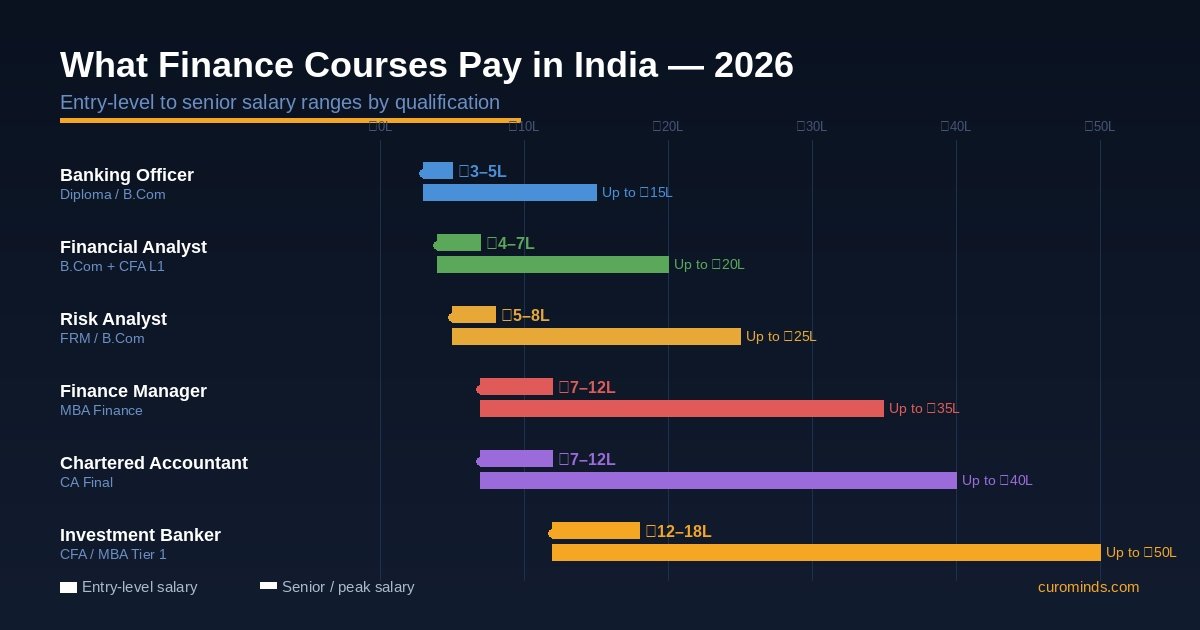
Salary data for finance roles varies a lot depending on the city, the employer, and how experienced you are. These numbers are from Glassdoor, AmbitionBox, and placement reports from 2024-2025. They represent realistic ranges, not best-case scenarios.
| Role | Qualification | Entry Salary | Senior Level Salary |
| Financial Analyst | B.Com + CFA Level 1 | Rs. 4 – 7 LPA | Rs. 12 – 20 LPA |
| Chartered Accountant | CA Final | Rs. 7 – 12 LPA | Rs. 20 – 40 LPA |
| Investment Banker | CFA / MBA Tier 1 | Rs. 12 – 18 LPA | Rs. 40+ LPA |
| Risk Analyst | FRM / B.Com | Rs. 5 – 8 LPA | Rs. 15 – 25 LPA |
| Portfolio Manager | CFA Charter | Rs. 8 – 15 LPA | Rs. 25 – 50 LPA |
| Finance Manager | MBA Finance | Rs. 7 – 12 LPA | Rs. 20 – 35 LPA |
| Banking Officer | Diploma / B.Com | Rs. 3 – 5 LPA | Rs. 8 – 15 LPA |
| Fintech Analyst | FMVA / B.Com + Excel | Rs. 4 – 8 LPA | Rs. 12 – 22 LPA |
Garima Mathur, who has counselled over 700+ students at CuroMinds, sees this mistake often: “Students from smaller cities assume they’re at a disadvantage. They’re not. A B.Com student who has cleared CFA Level 1 and knows Excel well can walk into a financial analyst interview anywhere in India and hold their own. The course matters less than what you can do with it.“
Here’s a simple way to decide based on where you are right now:
| Your Situation | Best Course |
| Just finished Class 12 commerce | B.Com + start CA Foundation in parallel |
| Class 12 science or arts, want to enter finance | BBA Finance or B.Com (all streams accepted) |
| Graduation done, want an investment or global finance role | CFA Level 1 — start preparation now |
| Want to work in risk at a bank or NBFC | FRM certification |
| Considering MBA but unsure about college quality | CFA unless you get into Tier 1 |
| Need a job in banking or broking within 6-12 months | NISM + Diploma in Banking |
| Working professional, want to upskill part-time | CMA, FRM, or FMVA — all workable part-time |
| Want to open your own CA practice eventually | CA from ICAI — the only route for statutory audit rights |
If you’ve read this and still aren’t sure which course fits your situation, that’s normal. The decision depends on things a generic article can’t know — your background, your city, your finances, what you actually want to do at work.
Book a career counselling session on CuroMinds.
Garima Mathur’s team works with students in Jaipur including nearby areas, including from tier 2 and tier 3 cities, and gives you a clear path, not a list of options to think about.
CA and CFA charterholders earn the most over a career. Senior CAs at Big 4 firms take home Rs. 20-40 LPA. CFA charterholders in investment banking often cross Rs. 25-30 LPA. IIM MBA placements in finance range from Rs. 25-50 LPA at the top colleges. These aren’t starting salaries. They reflect 5-10 years of experience.
Yes, and it’s more common than people assume. BBA Finance and B.Com are open to students from any stream. NISM and NSE Academy have no stream restriction. The only real barrier is math comfort — if you’re reasonably comfortable with numbers, stream doesn’t matter much.
Depends on the role. For broking and SEBI-regulated work, NISM certifications are mandatory, not optional. For corporate finance and analyst roles, FMVA from CFI is recognized. Both can be done in under 6 months and cost well under Rs. 1 lakh combined.
The BFSI sector added significant jobs through 2024 driven by mutual fund growth, retail investing, and fintech expansion. According to IBEF, the sector is on track for continued growth through 2030. The demand for people who can read financial statements, manage risk, and analyze investment options is real and consistent.
Depends on the role. For broking and SEBI-regulated work, NISM certifications are mandatory, not optional. For corporate finance and analyst roles, FMVA from CFI is recognized. Both can be done in under 6 months and cost well under Rs. 1 lakh combined.
There’s nothing women-specific about finance courses. CA, CFA, FRM, and MBA Finance have the same eligibility for everyone. The more relevant point: many firms in banking, financial planning, and asset management have active diversity hiring and are specifically looking for women in finance roles. The credential is the same. The hiring environment can actually work in your favour.