
Top 10 Toughest Exams in India (2026): Hardest Exams Ranked with Pass Percentage, Syllabus & Preparation Time
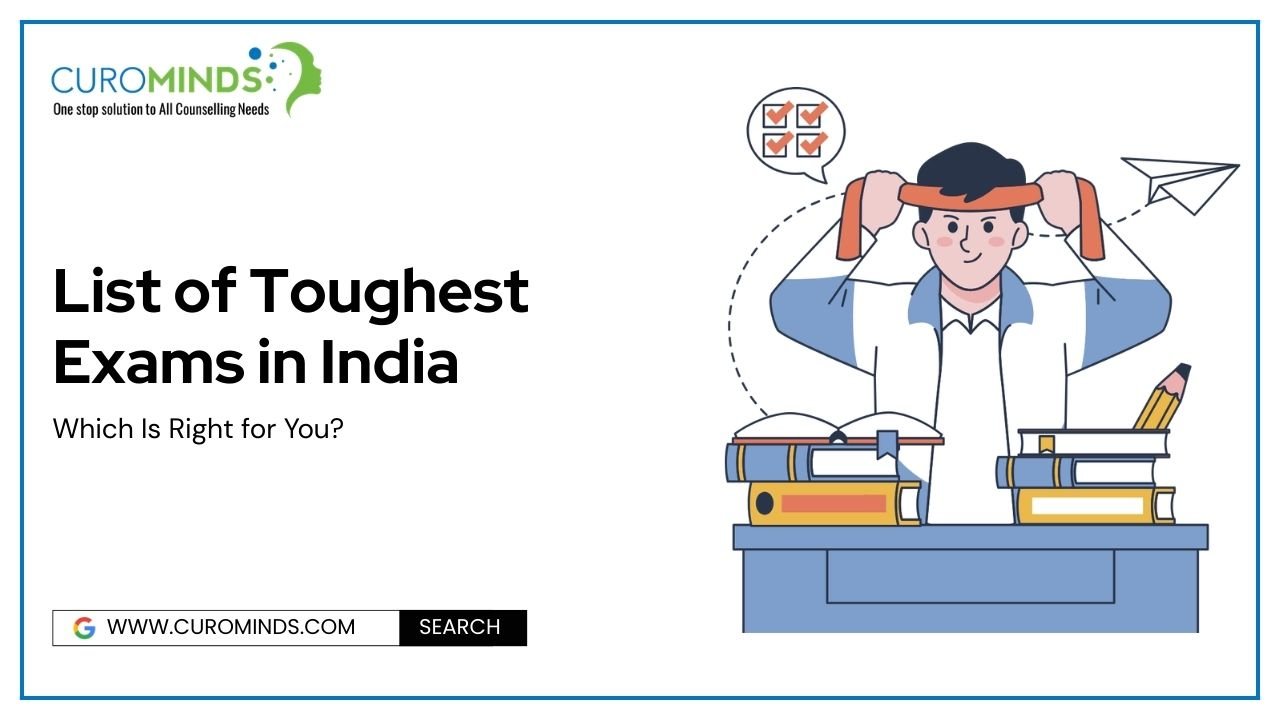

Toughest exams in India are not just hard because of their syllabus. They are hard because of what they demand simultaneously: months of preparation, low selection rates, high stakes, and in many cases, multiple elimination stages where clearing one round just gets you to a harder one.
A student preparing for UPSC CSE competes against roughly 900,000 to 1,000,000 applicants for around 1,000 final selections. That is not difficulty in the traditional academic sense — it is structured elimination at scale. JEE Advanced, CA Final, and GATE each have their own version of this equation.
This article ranks 15 of the most difficult exams in India based on selection ratio, syllabus complexity, number of stages, and average preparation time. Each exam covers pass percentage, what makes it genuinely hard, and a direct recommendation on who should attempt it. Pass percentages cited here are approximate — they vary year to year, so verify current figures at the official exam portal before building your plan.
What Makes an Exam the Toughest in India?
The toughest exams in India share four characteristics: a low selection ratio (fewer than 5% of serious candidates clear it), a multi-stage elimination structure, a broad and deep syllabus that takes 1 to 3 years to cover, and high cut-off volatility that makes past performance an unreliable predictor. Any exam that meets at least three of these criteria belongs on this list.
What does not make an exam tough: a large number of applicants alone, or a hard paper that most students find difficult in the moment. The true measure is how many qualified, well-prepared candidates the exam turns away — that is the real difficulty signal.
India Toughest Exam List 2026
| S. No. | Exam Name | Category | Approx. Pass % | Avg. Prep Time |
| 1 | UPSC CSE (IAS) | Government / Civil Services | Under 0.2% (all stages) | 2–4 years |
| 2 | JEE Advanced | Engineering Entrance | Under 10% | 2–3 years |
| 3 | CA Final | Professional | Under 15% per attempt | 3–5 years total |
| 4 | UPSC IES / ESE | Government / Engineering | Under 1% | 2–3 years |
| 5 | GATE | PG Entrance / PSU Jobs | 10–15% (varies by branch) | 1–2 years |
| 6 | NDA | Defence | Under 5% (all stages) | 1–2 years |
| 7 | NEET UG | Medical Entrance | Under 10% (govt seats) | 2–3 years |
| 8 | RBI Grade B | Banking / Finance | Under 1% | 1–2 years |
| 9 | CLAT (NLUs) | Law Entrance | 5–10% (NLU seats) | 1–2 years |
| 10 | UGC NET | Teaching / JRF | 5–10% (JRF under 3%) | 1–2 years |
| 11 | SSC CGL | Government / Central | Under 1% | 1–2 years |
| 12 | IBPS PO | Banking | Under 1% | 6–18 months |
| 13 | CDS | Defence | Under 5% | 6–18 months |
| 14 | XAT / CAT | MBA Entrance | Under 1% (top 5 IIMs) | 6–12 months |
| 15 | CUET (UG) | University Entrance | Varies by college/subject | 6–12 months |
Top 5 Toughest Exams in India 2026
The top 5 hardest exams in India are distinguished not just by low pass rates but by the combination of breadth, depth, competition volume, and multi-stage elimination. A student who clears Prelims still faces Mains, then Interview — and losing at any stage means starting over next year.
1. UPSC CSE: India’s Toughest Exam With the Lowest Selection Ratio
UPSC Civil Services Examination is consistently ranked the most difficult exam in India — and the numbers support it. Roughly 900,000 to 1,000,000 candidates register annually. Around 10,000 to 15,000 clear Prelims. Approximately 2,000 to 2,500 clear Mains. Around 1,000 make the final list. That is a sub-0.2% selection rate across all three stages for those who register.
The exam tests General Studies, an optional subject of your choice, essay writing, and a full personality test (interview). The optional subject alone has a syllabus comparable to a Master’s-level programme. A student from Patna who had cleared Mains twice before getting his final result on the third attempt described the interview as ‘the stage where two years of reading can either save you or sink you in 30 minutes.’ That is the nature of this exam.
Check the current UPSC CSE notification, syllabus, and exam calendar at the UPSC official website.
| Factor | Detail | What Makes It Hard | Who Should Attempt |
| Stages | Prelims → Mains → Interview | Three independent elimination rounds | Committed aspirants with 2+ years available |
| Syllabus | GS I–IV + Optional + Essay | 10+ papers in Mains alone | Strong readers with analytical writing ability |
| Pass % | Under 0.2% (all stages) | Highest competition volume in India | Verify current vacancy count at upsc.gov.in |
| Prep Time | 2–4 years average | Cut-off volatility year to year | Career counselling recommended before committing |
If you are weighing UPSC against other career paths, read our guide on career options after board exams to see the full picture before committing.
2. JEE Advanced: India’s Toughest Exam After 12th for Engineering
JEE Advanced is the entrance exam for IITs and is open only to students who clear JEE Main first. Around 160,000 to 180,000 students appear for JEE Advanced each year — all of them having already cleared one of the harder entrance exams in India. Of these, roughly 14,000 to 18,000 clear JEE Advanced. That gives a pass rate of under 10% among an already-filtered pool of candidates.
The paper tests Physics, Chemistry, and Mathematics at a depth that most 12th boards do not touch. Problems require multi-concept application under time pressure. A student who scored 95% in boards from Kota found JEE Advanced significantly harder than anything in his 12th curriculum — which is the point of the exam.
Current eligibility criteria, exam dates, and registration details are at the JEE Advanced official website.
| Factor | Detail | What Makes It Hard | Who Should Attempt |
| Stages | JEE Main (qualifying) → JEE Advanced | Must clear Main first; two attempts per year | PCM students targeting IIT specifically |
| Syllabus | PCM at extreme depth | Multi-concept problems, no direct formulae | Strong conceptual base from Class 11 onward |
| Pass % | Under 10% (of Advanced applicants) | Applicants are already JEE Main qualifiers | Verify cutoffs at jeeadv.ac.in |
| Prep Time | 2–3 years (Class 11–12 + dropper year if needed) | Highest-quality competition pool in India | Not worth attempting without serious commitment |
Students who missed JEE or are reconsidering their path can explore career counselling for JEE aspirants for a structured next step.
3. CA Final: India’s Hardest Professional Exam
CA (Chartered Accountancy) Final is conducted by ICAI. Pass rates for individual papers stay below 15% per attempt in most exam cycles. To reach CA Final, a student must first clear CA Foundation, CA Intermediate (both groups), and complete articleship — a journey that takes three to five years in total.
The difficulty is cumulative. You are not just clearing a hard paper; you are clearing a sequence of hard papers while working full-time articles. Most CA students appear for the Final exam two to four times before clearing. The ICAI itself publishes pass percentage data after every exam. Verify current pass rates at the ICAI official website before factoring these numbers into your plan.
Check current CA Final exam schedule, syllabus, and result data at the ICAI official website.
| Factor | Detail | What Makes It Hard | Who Should Attempt |
| Stages | Foundation → Intermediate → Articleship → Final | Each stage is an elimination; no shortcuts | Commerce students with strong accounting aptitude |
| Syllabus | 8 papers across two groups | Syllabus updates frequently; case-study based | Students committed to finance/audit careers |
| Pass % | Under 15% per paper per attempt | Even prepared candidates often need 2–4 tries | Verify current pass % at icai.org |
| Prep Time | 3–5 years total programme | Articleship runs parallel to exam prep | Support system and financial planning essential |
4. UPSC IES / ESE: Toughest Government Exam for Engineers in India
UPSC Engineering Services Examination (IES or ESE) is open to engineering graduates and leads to Class-1 gazetted officer posts in central government services. The exam tests engineering subjects at a depth comparable to postgraduate level. Around 200,000 to 250,000 candidates appear; roughly 500 to 600 posts are filled. That puts the effective selection ratio under 1%.
| Factor | Detail | What Makes It Hard | Who Should Attempt |
| Stages | Prelims → Mains → Personality Test | Three stages; engineering depth at each | Engineering graduates targeting Class-1 govt roles |
| Syllabus | Core engineering + General Studies | Postgraduate-level engineering questions | Civil, Mechanical, Electrical, Electronics branches |
| Pass % | Under 1% | Volume of engineering graduates competing | Verify current vacancies at upsc.gov.in |
| Prep Time | 2–3 years | GATE prep overlaps but is not sufficient alone | Best started in final year of B.Tech |
5. GATE: Toughest Engineering Entrance for PSUs and M.Tech in India
GATE (Graduate Aptitude Test in Engineering) is used for M.Tech admissions and PSU job recruitment. The pass rate — defined as scoring above a minimum qualifying mark — varies by branch and year but typically sits between 10% and 15% overall. For the top PSU cutoffs (ONGC, BHEL, IOCL), the effective selection rate is far below that.
What makes GATE genuinely hard is that 60% of the score comes from technical subject knowledge and 15% from Engineering Mathematics, with the remaining 25% from General Aptitude. The technical portion demands a depth most B.Tech programmes cover lightly. A student from Jaipur who had a 7.2 CGPA found his first GATE attempt harder than his entire engineering curriculum because GATE tests application, not memory.
| Factor | Detail | What Makes It Hard | Who Should Attempt |
| Eligibility | Final-year or passed B.Tech/B.Sc | High competition among experienced candidates | B.Tech students targeting PSU or M.Tech at IITs |
| Syllabus | Core technical + Engineering Maths + GA | 60% technical; no guess-and-clear strategy | Strong technical foundation required |
| Pass % | 10–15% overall; top PSU cutoff far lower | Multiple high scorers compete for few PSU seats | Verify current PSU cutoffs at each company HR |
| Prep Time | 1–2 years | Mock tests and previous papers are essential | Start from 3rd year B.Tech for best results |
Top 10 Toughest Exams in India in 2026
Exams on this list have lower average selection ratios than JEE Main or NEET but are underestimated by students who don’t research them before preparing. Each has a structural feature that makes it distinctly hard.
1. NDA: India’s Toughest Defence Exam After 12th
NDA (National Defence Academy) exam is conducted twice a year by UPSC. It is open to Class 12 students (or appearing) for admission to the Army, Navy, and Air Force wings of the NDA. The written exam covers Maths and General Ability. Clearing the written stage gets you to the SSB (Services Selection Board) — a five-day psychological and physical evaluation that eliminates the majority of those who clear the written round.
| Factor | Detail | What Makes It Hard | Who Should Attempt |
| Stages | Written (UPSC) → SSB (5 days) | SSB pass rate is very low even for written qualifiers | 12th PCM students with strong physical fitness |
| Syllabus | Maths + General Ability Test | SSB tests personality and leadership, not academics | Students with genuine interest in defence service |
| Pass % | Under 5% (across both stages) | High volume of aspirants; SSB is a real filter | Physical fitness standards must be met first |
| Prep Time | 1–2 years | SSB prep is different from written exam prep | SSB coaching is a separate preparation track |
2. NEET UG: India’s Toughest Medical Entrance Exam
NEET UG is the single entrance exam for all MBBS and BDS seats in India. In 2025, roughly 2.4 million students registered. The total MBBS seats (government + private) are around 110,000 to 115,000. For government college seats specifically, the effective competition is around 1 in 10 or lower depending on your state quota and category.
The difficulty of NEET is not just the Physics, Chemistry, and Biology syllabus — it is the consistency required across all three subjects simultaneously under a single attempt structure. Dropping marks in one subject cannot be compensated by scoring higher in another.
Students exploring PCB career paths outside NEET can read our guide on high salary courses after 12th science (PCB without NEET) for an honest comparison.
| Factor | Detail | What Makes It Hard | Who Should Attempt |
| Eligibility | 12th PCB, 50% aggregate | Single exam; one shot per year currently | PCB students committed specifically to MBBS/BDS |
| Syllabus | Physics + Chemistry + Biology (Class 11–12) | Equal weight across three subjects; no leeway | Deep conceptual clarity needed in all three |
| Pass % | Under 10% for govt MBBS seats | 2.4 million+ competing for 110,000 seats | Verify current seat matrix at mcc.nic.in |
| Prep Time | 2–3 years | Repeat attempts are common and structurally allowed | Strategy and subject balance matter as much as marks |
3. RBI Grade B: Toughest Banking Exam in India
RBI Grade B is the entry-level officer exam for the Reserve Bank of India — arguably the most prestigious banking job in India after the IAS route. The number of vacancies is typically under 300 per year, against tens of thousands of serious applicants with strong economics and finance backgrounds.
| Factor | Detail | What Makes It Hard | Who Should Attempt |
| Stages | Phase I (Objective) → Phase II (Descriptive) → Interview | Three stages; each acts as a hard filter | Graduates with Economics/Finance background |
| Syllabus | Economics, Finance, Management, General Awareness | Phase II requires essay-quality economic analysis | Strong reading habit in finance and economy essential |
| Pass % | Under 1% | Very few vacancies; applicant quality is high | Verify current vacancies at rbi.org.in |
| Prep Time | 1–2 years (dedicated) | Phase II descriptive prep is often underestimated | Career counselling before committing helps |
4. CLAT: India’s Toughest Law Entrance Exam
CLAT (Common Law Admission Test) is the entrance exam for the 24 National Law Universities (NLUs). The total number of undergraduate seats across all NLUs is around 2,500 to 2,800. Around 70,000 to 80,000 students appear annually. For top NLUs like NLSIU Bangalore and NALSAR Hyderabad, the effective competition is far higher than the overall ratio suggests.
| Factor | Detail | What Makes It Hard | Who Should Attempt |
| Stages | Single exam, no physical/interview stage | Cut-off precision is the main challenge | 12th students from any stream targeting law |
| Syllabus | English, GK, Legal Reasoning, Maths, Logic | Reading comprehension speed and legal analysis | Strong English readers with analytical thinking |
| Pass % | 5–10% (NLU seats); top NLU much harder | Rank determines which NLU you get, not just clearing | Verify cut-offs at consortiumofnlus.ac.in |
| Prep Time | 1–2 years | Mock test performance predicts real score well | Reading current affairs daily from Class 11 |
5. UGC NET: India’s Toughest Exam for Teaching Aspirants
UGC NET (National Eligibility Test) is the qualifying exam to become an Assistant Professor or Junior Research Fellow (JRF) in Indian universities. The overall pass rate for NET eligibility is 5 to 10%. For JRF — which comes with a stipend and higher prestige — the effective selection rate is under 3% of those who appear.
Graduates considering a teaching career should also read our guide on career options after graduation to compare this path against others.
| Factor | Detail | What Makes It Hard | Who Should Attempt |
| Eligibility | Postgraduate degree in relevant subject | Must score above NET cut-off in two papers | Postgraduates targeting college teaching or research |
| Syllabus | Paper I (Teaching Aptitude) + Paper II (Subject-specific) | Subject paper depth equals postgraduate level | Students with strong academic interest in their subject |
| Pass % | 5–10% NET; under 3% for JRF | JRF cut-off is significantly higher than NET | Verify current cut-offs at ugcnet.nta.ac.in |
| Prep Time | 1–2 years | Paper I is often underpreparated and costly | Mock tests for Paper I speed are as important as Paper II |
Top 15 Toughest Exams in India in 2026
These five exams have high competition volumes and low selection rates. They are often underestimated because students assume familiarity with the subject area translates to exam readiness. It rarely does.
11. SSC CGL: Toughest Government Exam in India for Graduates
SSC CGL (Combined Graduate Level) fills posts across central government departments. Around 3 to 4 million candidates apply annually for approximately 10,000 to 20,000 posts. The effective selection rate is under 1%. Four tiers — Tier 1, Tier 2 (now merged), and document verification — each eliminate a significant fraction.
For a full list of government exams after 12th and beyond, see our guide on government exams after 12th.
| Factor | Detail | What Makes It Hard | Who Should Attempt |
| Stages | Tier 1 (CBT) → Tier 2 (CBT) → Document Verification | Cut-off precision required at each stage | Any graduate targeting central government posts |
| Syllabus | Quant, Reasoning, English, General Awareness | No single weak subject tolerated at Tier 1 | Strong in at least two of the four sections |
| Pass % | Under 1% | 3–4 million applicants; few vacancies | Verify current vacancy and cut-off at ssc.gov.in |
| Prep Time | 1–2 years | English and GA are the differentiators at Tier 2 | Mock test consistency matters more than raw study hours |
Students targeting central government roles can also explore our guide on central government exams in India for a comprehensive overview.
12. IBPS PO: Toughest Banking Exam for General Graduates
IBPS PO (Probationary Officer) is the most volume-heavy banking exam in India. Around 8 to 10 million candidates register; approximately 3,000 to 5,000 posts are filled per cycle. The selection rate across all three stages (Prelims, Mains, Interview) is under 0.1% of registrants.
| Factor | Detail | What Makes It Hard | Who Should Attempt |
| Stages | Prelims → Mains → Interview | Three stages; each a fresh cut-off | Any graduate targeting nationalised bank PO posts |
| Syllabus | Quant, Reasoning, English, Banking Awareness | Mains adds Data Analysis and a descriptive paper | Stronger in Quant and Reasoning typically does better |
| Pass % | Under 0.1% of registrants | One of the highest applicant volumes in India | Verify current vacancies at ibps.in |
| Prep Time | 6–18 months | Speed and accuracy at Prelims is non-negotiable | Start with Prelims mock tests before touching Mains syllabus |
13. CDS: India’s Toughest Defence Exam for Graduates
CDS (Combined Defence Services) exam is for entry into the Indian Military Academy, Indian Naval Academy, Air Force Academy, and Officers Training Academy. Conducted twice a year by UPSC, it requires graduation as the minimum qualification and includes a mandatory SSB interview that clears fewer than 30% of written qualifiers.
| Factor | Detail | What Makes It Hard | Who Should Attempt |
| Stages | Written (UPSC) → SSB (5 days) | SSB is a psychological and leadership filter | Graduates with genuine interest in military service |
| Syllabus | English + GK + Elementary Maths | SSB tests personality more than academics | Physical fitness standards are non-negotiable |
| Pass % | Under 5% (across both stages) | SSB rejects most written qualifiers | Verify current vacancies at upsc.gov.in |
| Prep Time | 6–18 months (written) + SSB prep | SSB preparation is a distinct skill set | Mock SSB sessions are as important as written prep |
14. CAT / XAT: India’s Toughest MBA Entrance Exams
CAT (Common Admission Test) is the gateway to IIMs and hundreds of other business schools. Around 330,000 to 350,000 students appear annually for CAT. Approximately 1,200 to 1,500 students get into the top 5 IIMs — a selection rate of roughly 0.4% from the applicant pool. XAT is similarly competitive for XLRI Jamshedpur.
| Factor | Detail | What Makes It Hard | Who Should Attempt |
| Eligibility | Graduate from any stream, 50% marks | Top IIM cut-off: 99+ percentile in each section | Graduates from any stream with strong aptitude |
| Syllabus | Verbal, Quant, DILR | DILR section is notoriously unpredictable | Students with strong reading and data analysis habits |
| Pass % | Under 0.4% for top 5 IIMs | Many high scorers still don’t convert interviews | Verify cut-offs at official IIM websites |
| Prep Time | 6–12 months | Interview and WAT prep is a separate track | Attempt mock CATs 3 months before the exam |
15. CUET UG: India’s Newest High-Volume University Entrance Exam
CUET (Common University Entrance Test) was introduced as a single entrance exam for central university UG admissions. In 2025, over 1.3 million students registered. For top colleges like Delhi University’s top programmes, the effective cut-off is at the 99th percentile or above — despite the exam being relatively newer than others on this list.
Students choosing between CUET and other entrance exams after 12th can get a full comparison in our guide on entrance exams after 12th in India.
| Factor | Detail | What Makes It Hard | Who Should Attempt |
| Eligibility | 12th from any stream (subject-specific) | Domain subject and Language papers both required | 12th students targeting central university admissions |
| Syllabus | Domain subject + Language + General Test | Cut-offs for top DU courses are extremely high | Strong 12th board score helps but is not the only factor |
| Pass % | Varies by college and programme | 1.3 million applicants; top programmes very competitive | Verify cut-offs at cuet.samarth.ac.in |
| Prep Time | 6–12 months | Domain subject is same as 12th syllabus but competitive | NCERT mastery is the foundation for CUET prep |
How to Prepare for India’s Toughest Exams
- Choose based on what the role demands daily, not just the prestige. An IAS officer runs district administration. A CA handles audits and client advisory. An IIT graduate writes code or designs systems. If you are drawn to the outcome, the preparation will sustain you. If you are only drawn to the rank or salary, it usually won’t.
- Assess your realistic preparation window before choosing the exam. UPSC needs 2 to 4 years. JEE Advanced needs 2 to 3 years from Class 11. CA Final takes 3 to 5 years total. CAT needs 6 to 12 months of structured prep. Choose an exam your timeline can actually support, not the one with the most impressive outcome.
- Build your foundation before signing up for coaching. Every toughest exam in India has a preparation industry around it. Coaching is helpful for some of them — but paying for coaching before you know your basics is wasted money. Spend 60 days on NCERT, basic maths, or your subject fundamentals first. Then assess whether you need structured support.
- Use previous years’ question papers as your first diagnostic, not your last revision tool. Sit with a real previous paper under timed conditions before starting any course. Your score tells you where you are now, which tells you how much time you actually need. Most students skip this step and overestimate their readiness.
For guidance on which option suits your academic background and goals, explore our career counselling for 12th students page.
My Honest Take
Every toughest exam on this list is hard partly because of the syllabus and partly because of who else is writing it. You are not competing against a test — you are competing against tens of thousands of equally prepared, equally motivated people. That is a different problem, and it requires a different solution.
The students who consistently clear the toughest exams in India are not necessarily the ones who studied the most hours. They are usually the ones who started earlier, stayed consistent longer, and treated diagnostic tests as tools rather than threats. A student from Lucknow who cleared UPSC CSE on his second attempt told me his first attempt taught him more than the entire first year of preparation — because failure, taken honestly, is data.
If you are a Class 10 or 12 student reading this to decide which career path to prepare for: the exam ranking matters less than your genuine interest in the role on the other side of it. An IAS officer governs. A CA advises. An IIT graduate engineers. Pick the life, not the rank. The preparation that follows will be harder to quit.
And if you are a parent reading this for your child: the most important thing you can do is help them make the choice freely, with accurate information, not societal pressure. Career counselling before committing to a 2-to-4-year exam preparation saves more time than any shortcut.
For personalised guidance on choosing the right competitive exam based on your academic profile, city, and goals, book a free counselling session with a CuroMinds advisor — we work specifically with students and parents who want a clear, honest decision before committing years to exam preparation.
Further Reading on CuroMinds
- Competitive Exams After 12th in India: Full List — Complete guide to every entrance and government exam open after Class 12
- Government Exams After 12th: Eligibility, Pattern and Career Scope — State and central government exam options for 12th pass students
- Entrance Exams After 12th in India: Science, Commerce and Arts — Stream-wise breakdown of all major entrance exams after Class 12
- Easiest Government Exams After 12th in India — For students who want government jobs with a more accessible entry point
- Didn’t Crack JEE? Career Counselling for JEE Aspirants — What to do if JEE didn’t go as planned — honest options and next steps
- Career Options After Board Exams: What to Do Next — Broader career mapping for students deciding after Class 12 results
- Career Counselling for 12th Students Before College Admission — Why getting counselled before choosing a course saves years of confusion
- Upcoming Government Exams in 2026 — Current exam calendar for central and state government recruitments
- Central Government Exams: Complete List With Eligibility — All UPSC, SSC, banking, and defence exams covered in one place
- Career Anxiety in Students: What It Is and How to Handle It — For students feeling overwhelmed by exam pressure and career decisions
- High Salary Courses After 12th Science (PCB Without NEET) — Alternatives for PCB students who want a medical career without NEET
- Career Options After Graduation: What Comes After a Degree — Competitive exam and career options for graduates choosing their next step
FAQs
UPSC CSE (IAS exam) is widely considered the toughest exam in India based on selection ratio. Under 0.2% of registered candidates make the final merit list across all three stages. JEE Advanced is the toughest entrance exam after 12th specifically for engineering, with a pass rate under 10% among an already-filtered applicant pool.
The top 3 toughest exams in India are: (1) UPSC CSE with a sub-0.2% all-stage selection rate, (2) JEE Advanced with under 10% pass rate among qualified applicants, and (3) CA Final with a pass rate under 15% per attempt after a multi-year programme.
UPSC CSE has an approximate pass percentage of under 0.2% across all stages. JEE Advanced clears under 10% of those who appear (already JEE Main qualifiers). CA Final clears under 15% per attempt. These figures vary year to year — verify current data at each official exam body.
Among government exams in India, UPSC CSE is the toughest by selection ratio and multi-stage structure. UPSC IES (Engineering Services) is the hardest for engineering graduates. RBI Grade B is considered the hardest banking exam. SSC CGL has the most volume-difficulty combination among all central government exams.
JEE Advanced is the hardest entrance exam in India after 12th. NDA is the hardest defence exam after 12th. NEET UG is the hardest medical entrance. CLAT is the hardest law entrance. All four require at least 1 to 2 years of focused preparation beyond Class 12 boards.