
100+ Best Career Options in India 2026: Salary, Eligibility, Courses & Future Scope


India offers over 100 legitimate career options in India across technology, healthcare, finance, law, engineering, government services, creative arts, and emerging fields. The right career depends on your stream, interests, qualification timeline, and what kind of work you genuinely want to do every day — not just what pays the most or what your family expects.
This blog covers all of them. Across six reference tables, you will find 112 specific careers mapped to their entry routes, qualifications, and growth outlook.
Key Takeaways
- India has 100+ viable career paths across technology, healthcare, finance, law, engineering, government, creative arts, and emerging fields like AI and climate science.
- The highest-paying careers in India in 2026 are in AI/ML, investment banking, medicine, law (corporate), and data science — but salary depends on qualification, city, and experience.
- Career options after 10th include ITI trades, polytechnic diplomas, and vocational courses. After 12th, options expand significantly across all streams.
- Emerging careers — AI engineering, prompt engineering, EV technology, climate analysis, and mental health counselling — are growing fastest in India right now.
- All salary figures in this article should be verified at nationcareercservice.nic.in or official recruitment portals. Published ranges vary and are not guaranteed outcomes.
What Are the Best Career Options in India in 2026?
The best career options in India in 2026 are not just the highest-paying ones. They are the ones where demand is growing, entry routes are clear, and the skills are learnable. Technology, healthcare, AI, law, and government services top the list — but the “best” career for any individual depends on stream, aptitude, and how much preparation time they are willing to invest.
India’s economy is creating specific types of jobs faster than others. AI and data roles, digital marketing, healthcare (especially mental health and telemedicine), and renewable energy are growing faster than traditional manufacturing and administrative roles.
100+ Career Options in India by Sector
The table below organises 112 careers across 12 sectors. Use it to find the sector that suits your background, then explore the specific careers in the detailed sections.
| Career Sector | Example Careers | Min. Qualification | Career Scope |
| Technology & IT (18) | Software Dev, Data Scientist, AI/ML Engineer, Cybersecurity Analyst, Cloud Architect, DevOps, UI/UX, Product Manager, Blockchain Dev, AR/VR Dev, IoT Engineer, Data Analyst, Network Engineer, Mobile Dev, Web Dev, QA Engineer, IT Project Manager, Database Admin | B.Tech/BCA/BSc CS or self-taught with portfolio | Very High — global demand, remote-friendly |
| Finance & Banking (12) | CA, Investment Banker, CFA, CS, CMA, Financial Analyst, Actuary, Stock Broker, Bank PO, CFP, Tax Consultant, Wealth Manager | BCom + CA/CFA/MBA or professional exam | High — stable, growing in fintech |
| Healthcare & Medical (10) | Doctor (MBBS), Dentist (BDS), Pharmacist, Physiotherapist, Nurse, Lab Technologist, Radiographer, BAMS, Occupational Therapist, Healthcare Admin | MBBS/BDS/B.Pharm/BSc Allied Health | Very High — post-pandemic demand surge |
| Engineering (12) | Mechanical, Civil, Electrical, Electronics, Chemical, Aerospace, Environmental, Structural, Automotive, Marine, Nuclear, Agricultural Engineer | B.Tech / BE (4 years) | High — varies by specialisation and sector |
| Government Services (8) | IAS/IPS/IFS, SSC CGL/CHSL, IBPS Bank PO, Army/Navy/Air Force Officer, Railway Officer, RBI Grade B, SEBI Grade A, State Services | Graduation (some from Class 12) | Very High Prestige — official pay scales, pension |
| Creative & Media (10) | Graphic Designer, Animator, VFX Artist, Video Editor, Content Creator, Journalist, Fashion Designer, Interior Designer, Filmmaker, Social Media Manager | Diploma/Degree or self-built portfolio | Growing — digital economy, OTT, D2C brands |
| Business & Management (8) | MBA Marketing/HR/Operations, Business Analyst, Supply Chain Manager, Management Consultant, E-commerce Manager, Entrepreneur | BBA/BCom + MBA or equivalent | High — spans all sectors |
| Law (5) | Corporate Lawyer, Criminal Lawyer, IP Lawyer, Tax Lawyer, Legal Consultant | LLB (3 yrs) or BBA/BCom + LLB (5 yrs integrated) | High — corporate law and tax growing fast |
| Education (6) | School Teacher, College Professor, Educational Psychologist, Corporate Trainer, EdTech Creator, School Principal | B.Ed / MA / PhD (for college) | Stable — EdTech significantly expanding scope |
| Emerging/AI Careers (12) | Prompt Engineer, AI Product Manager, ML Researcher, Data Privacy Specialist, Digital Marketer, Climate Analyst, Space Tech, Robotics Engineer, Biotech Researcher, Genetic Counsellor, EV Engineer, Mental Health Counsellor | Varies — degree + skill certification | Very High Growth — most under-supplied |
| Agriculture & Environment (7) | Agricultural Scientist, Food Technologist, Environmental Scientist, Forest Officer, Horticulture Expert, Fisheries Officer, Organic Farming Consultant | BSc Agriculture / B.Tech Agri | Growing — climate focus driving demand |
| Social Sciences (5) | Psychologist, Sociologist, Social Worker (MSW), Development Sector Professional, NGO Manager | BA/MA Social Sciences + PG | Moderate — mental health demand rising fast |
Highest Paying Career Options in India in 2026
The highest paying careers in India in 2026 are concentrated in AI/ML, investment banking, medicine, law, and data science. These are also careers with the longest and most rigorous preparation timelines — which is why the pay is high. The scarcity of truly qualified professionals drives compensation in all of them.
| Career | Min. Qualification | Salary Outlook | Why It Pays Well in India |
| AI/ML Engineer | B.Tech CSE or equivalent | High (verify at NCS portal) | Global shortage; India a major AI talent hub |
| Investment Banker | BCom/BBA + MBA Finance | Very High (verify at NCS) | Deals, M&A, IPOs — high performance pay |
| Doctor (MBBS + Specialist) | MBBS + MD/MS | High to Very High | Post-COVID healthcare expansion, urban demand |
| Corporate Lawyer (NLU) | LLB / LLM from top college | High | Contract-heavy economy; M&A and IP activity |
| Data Scientist | B.Tech/BSc + Data Science skills | High (verify at NCS) | Data-driven business decisions across all sectors |
| Chartered Accountant (CA) | CA from ICAI | High — depends on sector | Audit, Big 4, CFO roles; scarce talent supply |
| Actuary | Graduation + IAI exams | Very High (verify at NCS) | Risk modelling; very few qualified actuaries in India |
| Product Manager (Tech) | B.Tech or MBA + PM skills | High | Startup ecosystem; product-led growth companies |
| Civil Services (IAS/IFS) | Graduation + UPSC | Official 7th Pay Commission scale | Prestige + government benefits + influence |
| Aerospace Engineer | B.Tech Aerospace / Mechanical | High (ISRO, DRDO, private) | India space policy + private space sector growth |
* All salary references are indicative. Verify at nationcareercservice.nic.in or official recruitment portals. Private-sector compensation is not officially published and varies significantly.
Career Options After 10th in India
Career options after 10th in India primarily involve choosing between continuing formal education (Class 11-12) or entering a vocational or technical track. The honest answer for most students: continuing to Class 11-12 opens more doors later than any short-term course at 16. But for students who cannot continue due to economic constraints, ITI trades and polytechnic diplomas are legitimate, well-structured options.
ITI programmes are NCVT-recognised, take 1-2 years, and provide direct entry into government apprenticeships and PSU technical roles. Polytechnic diplomas take 3 years but provide lateral entry into the second year of B.Tech — which means a diploma student can complete a B.Tech in just 3+2 = 5 years total.
For students after Class 8 thinking ahead, career counselling for students after Class 8 explains why the Class 9-10 years are where long-term options are actually shaped — specifically which subjects to take in Class 11.
| Career Path | Course / Route | Duration | Where It Leads |
| ITI Trade (Electrician, Fitter, Welder, Mechanic) | ITI from NCVT-recognised institute | 1-2 yrs | Government apprenticeships, PSU jobs, self-employment |
| Polytechnic Diploma (Civil, Mechanical, Electronics) | Diploma programme from state polytechnic | 3 yrs | Lateral entry to B.Tech (2nd year) or government jobs |
| Computer Applications (CCA/DCA) | Diploma in Computer Applications | 6m-1yr | Data entry, office work, basic IT roles |
| Banking/Commerce Diploma | Short-term banking and accounts course | 6m-1yr | Tally operator, accounts assistant, bank clerk prep |
| Agricultural Training | ICAR / state agri university programme | 1-2 yrs | Farm management, agri business, rural employment |
| Class 11-12 (all streams) | Continue formal education | 2 yrs | Opens all career paths — best long-term decision |
Career Options After 12th in India
Career options after 12th in India are more stream-dependent than at any other stage. Science PCM opens engineering and architecture. Science PCB opens medicine and pharmacy. Commerce with Maths opens CA and finance. Commerce without Maths and Arts open equally wide paths in law, management, journalism, design, and government services.
The most important decision at 12th is not which career to choose — it is which stream to choose in Class 11. That stream determines which competitive exams you can attempt. Most students make this decision without understanding its consequences, which is why career counselling at this stage has an unusually high return on investment.
The importance of career counselling after 12th standard addresses specifically what students face when making this decision — and what the data shows about outcomes when they have structured guidance versus none.
| Stream | Strongest Career Path | Course | Duration |
| Science (PCM) | Engineering / Architecture / IT | B.Tech / B.Arch | 4-5 yrs |
| Science (PCB) | Medicine / Pharmacy / Biotech | MBBS / B.Pharm / BSc Biotech | 3-5 yrs |
| Commerce (with Maths) | Chartered Accountancy / Finance | CA Foundation + B.Com | 3-5 yrs |
| Commerce (without Maths) | Company Secretary / Digital Marketing | CS / BBA / Digital cert. | 3-4 yrs |
| Arts/Humanities | Law / Journalism / Civil Services | LLB / BA Mass Comm / BA | 3-5 yrs |
| Any Stream | Digital Marketing / Design / AI | Short cert + portfolio | 3-12 months |
Career Options After Graduation in India
Career options after graduation in India depend on what you studied — and what you did during those three or four years. A BCom graduate who also cleared CA Intermediate is in a fundamentally different position from one who holds only the degree. A BSc Computer Science graduate who built a project portfolio is more hireable than one who studied without practising.
For graduates who find themselves confused about next steps, how to choose the right programme for career clarity is a direct, practical read on the decision-making process. And how career counselling helps in getting a desired job covers the mechanism by which structured guidance converts to better hiring outcomes.
The clearest post-graduation paths by outcome type:
- Highest salary ceiling: MBA from top-20 NIRF institute, CA qualification, UPSC Civil Services.
- Fastest to employment (6-12 months): Digital marketing, UI/UX design, data analytics, prompt engineering with certification.
- Most stable long-term: Government services (IBPS, SSC, UPSC), PSU technical roles, teaching with NET qualification.
- Best for entrepreneurship: E-commerce, EdTech, agriculture tech, health tech — sectors where India has growing startup activity.
Emerging and Future Career Options in India
The emerging careers in India in 2026 are concentrated in AI, climate, digital health, space, and mental wellness. These fields are growing for a clear reason: demand is outpacing supply. India has very few trained climate analysts, data privacy specialists, and mental health professionals relative to the population that needs these services.
The future of career counselling as a career shows how even traditional advisory professions are being reshaped by emerging skill requirements. The pattern repeats across sectors: those who add emerging credentials to traditional degrees consistently outperform those who hold only the degree.
| Emerging Career | Why Growing in India | Key Skills Needed | Entry Route |
| AI / ML Engineer | Every sector adopting AI; India a global AI talent hub | Python, TensorFlow, statistics, model training | B.Tech CSE + AI specialisation or self-paced ML courses |
| Prompt Engineer | AI tools integrated into every job; prompt skills newly valued | ChatGPT, Gemini, Claude; structured prompting | Free courses (Google, DeepLearning.AI) + portfolio |
| EV / Sustainability Engineer | India EV policy push; global net-zero commitments | Battery systems, power electronics, charging infra | B.Tech Electrical/Mechanical + EV specialisation |
| Data Privacy Specialist | DPDP Act 2023 creates compliance demand in India | GDPR/DPDP law, CIPP certification, risk audit | Law + tech background or CIPP certification |
| Mental Health Counsellor | Post-pandemic demand; youth mental health crisis visible | Psychology, empathetic communication, CBT basics | MA Psychology + RCI registration |
| Climate Change Analyst | India climate commitments; corporate ESG mandates | Environmental science, carbon accounting, GIS | BSc/MSc Environmental Science + ESG certification |
| Space Tech Engineer | ISRO + private space sector (Skyroot, Agnikul) growing fast | Aerospace, propulsion, orbital mechanics | B.Tech Aerospace/Mechanical + space specialisation |
| Healthcare AI Specialist | Digital health, AI diagnostics, health data analytics | Medical background + data science / ML skills | MBBS or BPT + AI/data science upskilling |
Top AI Career Options in India
AI career options in India are the fastest-growing sector in the Indian job market right now. The highest paying careers in India are increasingly AI-adjacent — and the most in-demand is not always the most technically complex. AI Product Manager, Prompt Engineer, and AI Trainer roles are accessible to non-engineering graduates with targeted upskilling.
For technical AI roles (ML Engineer, AI Researcher), a B.Tech in Computer Science with specialisation in ML is the clearest path. Python, TensorFlow or PyTorch, statistics, and experience with real model-building projects are the minimum portfolio requirement.
For non-technical AI roles (AI content strategist, prompt engineer, AI project manager), the path is shorter — free courses from DeepLearning.AI and Google, a portfolio of real AI-assisted work, and a certificate from a recognised provider. Most of these roles can be entered within 3-6 months of targeted preparation.
Why career counselling is a need of the hour covers the specific point that AI is reshaping which careers grow — and counsellors who understand AI can advise students far more accurately on which path to invest time in.
This is custom heading element
I am text block. Click edit button to change this text. Lorem ipsum dolor sit amet, consectetur adipiscing elit. Ut elit tellus, luctus nec ullamcorper mattis, pulvinar dapibus leo.
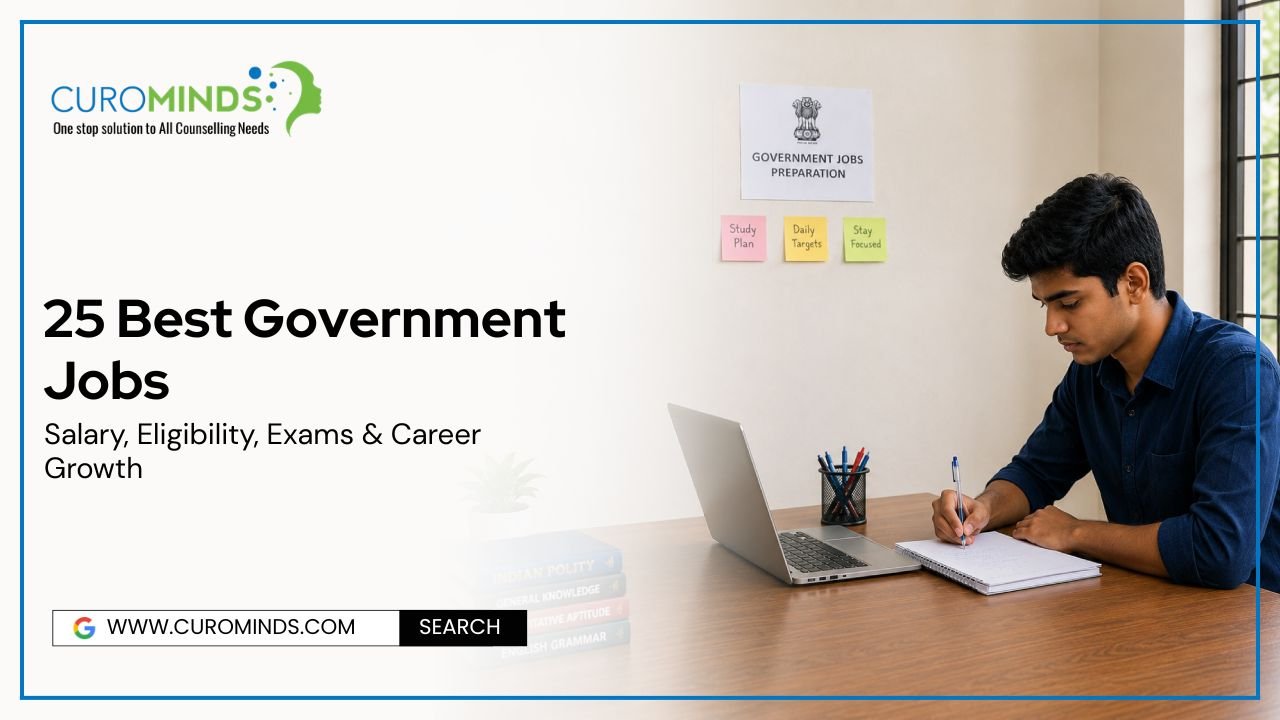
Top Government Career Options in India
Government career options in India remain among the most stable and prestigious across Tier 2 and Tier 3 cities. UPSC Civil Services, SSC, IBPS banking, defence services, and railway officer roles all have defined selection processes, official pay scales under the 7th Pay Commission, and structured career progression.
Why students think career counselling is a good idea for government job preparation specifically covers this: a counsellor can help you map which exam suits your educational background and realistic preparation timeline — preventing the common mistake of pursuing the wrong exam for three years before realising it.
| Government Career | Key Exam / Route | Min. Qualification | Pay Scale Reference |
| IAS / IPS / IFS | UPSC Civil Services | Graduation (any) | 7th Pay Commission Level 10+. Verify at upsc.gov.in |
| SSC CGL Officer | SSC Combined Graduate Level | Graduation | Pay Level 4-8. Verify at ssc.gov.in |
| Bank PO (IBPS / SBI) | IBPS PO / SBI PO Exam | Graduation (any) | JMG Scale I. Verify at ibps.in or sbi.co.in |
| RBI Grade B Officer | RBI Direct Recruitment | Graduation (60%+) | Grade B pay scale. Verify at rbi.org.in |
| Defence Officer (Army/Navy/Air Force) | NDA / CDS / AFCAT | Class 12 / Graduation | Service pay matrix. Verify at joinindianarmy.nic.in |
| Railway Group A Officer | UPSC Engineering Services / Civil Services | B.Tech / Graduation | Pay Level 10+. Verify at indianrailways.gov.in |
| SEBI Grade A Officer | SEBI Direct Recruitment | Graduation | SEBI pay scale. Verify at sebi.gov.in |
| Gramin Dak Sevak (GDS) | Merit in Class 10 marks — no exam | Class 10 | TRCA. Verify at indiapost.gov.in |
* All government pay scales based on 7th Pay Commission. Verify current pay bands at official recruitment portals listed in the table.
How to Choose the Right Career Option in India
Choosing a career from 100+ options sounds difficult. It becomes simple when you use a framework instead of a feeling. Here is the one that works.
- List what you are genuinely good at. Not what you wish you were good at — what you actually do well right now.
- List what interests you enough to study for five years. Interest is the fuel. Without it, most people drop out of demanding qualifications.
- Check whether there is a realistic market for that career in your city or remotely. A career with no local market and no remote option is a problem for Tier 2-3 city students.
- Map your current qualifications to available entry routes. What do you have now? What can you earn or qualify for in the next 12 months?
- Verify salary ranges at official portals. At nationcareercservice.nic.in for government roles. On Naukri or LinkedIn Salary for private sector estimates.
If this framework produces multiple viable options and you are still stuck, that is exactly the situation where career counselling provides the clearest value. A counsellor does not make your decision for you. They help you understand your options better — which leads to decisions you can stand behind years later.
Final Take
Every article about career options in India gives you a list. Very few of them tell you the harder truth: the career that suits you is not the most popular one or the highest-paying one. It is the one where your natural strengths, your realistic preparation timeline, and the actual market demand intersect.
The information in this blog — 112 careers, six tables, eight FAQs — is a foundation. What it cannot do is tell you which section applies to your life. That is the part that requires honest self-assessment, and usually, the perspective of someone who has helped other people navigate the same decision.
CuroMinds connects students and professionals across India with counsellors who understand both the career landscape and the human side of these decisions. An introduction to CuroMinds explains how the platform works. The 5 misconceptions about applying for career counselling addresses the most common hesitations honestly. And why career counselling is a need of the hour is worth reading if you are still on the fence about whether structured guidance is necessary at this stage of your journey.
FAQs
AI/ML engineering, investment banking, medicine (specialist), corporate law, and actuarial science typically lead in compensation. Exact figures depend on qualification, employer, city, and experience. Verify current salary ranges at nationcareercservice.nic.in before making decisions based on any published number.
The strongest career paths after 12th depend on your stream. Science PCM: engineering or architecture. Science PCB: medicine or pharmacy. Commerce: CA, CS, or digital marketing. Arts: law, journalism, civil services, or design. All streams: AI-related short courses and digital skills are universally accessible.
After 10th, the practical options are ITI trades (1-2 years), polytechnic diplomas (3 years with B.Tech lateral entry), basic computer courses, and continuing to Class 11-12. Continuing formal education remains the option with the highest long-term career flexibility.
AI/ML engineering, data science, cybersecurity, UI/UX design, digital marketing, mental health counselling, EV engineering, and healthcare (especially rural and telemedicine) are the most in-demand careers in India in 2026. All are growing faster than the supply of qualified professionals.
Careers in AI, data science, renewable energy, healthcare (mental health, digital health), and climate science have the strongest long-term outlook in India. These fields have documented government policy support and growing market demand that exceeds current professional supply.
Graduates can access UPSC Civil Services, SSC CGL, IBPS bank exams, RBI Grade B, SEBI, railway officer posts, and numerous state-level government roles. All have official 7th Pay Commission pay scales. Verify current pay bands and eligibility at official recruitment portals.
Ac non ac hac ullamcorper rhoncus velit maecenas convallis torquent elit accumsan eu est pulvinar pretium congue a vestibulum suspendisse scelerisque condimentum parturient quam.Aliquet faucibus condimentum amet nam a nascetur suspendisse habitant a mollis senectus suscipit a vestibulum primis molestie parturient aptent nisi aenean.A scelerisque quam consectetur condimentum risus lobortis cum dignissim mi fusce primis rhoncus a rhoncus bibendum parturient condimentum odio a justo a et mollis pulvinar venenatis metus sodales elementum.Parturient ullamcorper natoque mi sagittis a nibh nisi a suspendisse a.