
Humanities Subjects List 2026: Best Subjects, Careers, Salary & Future Scope
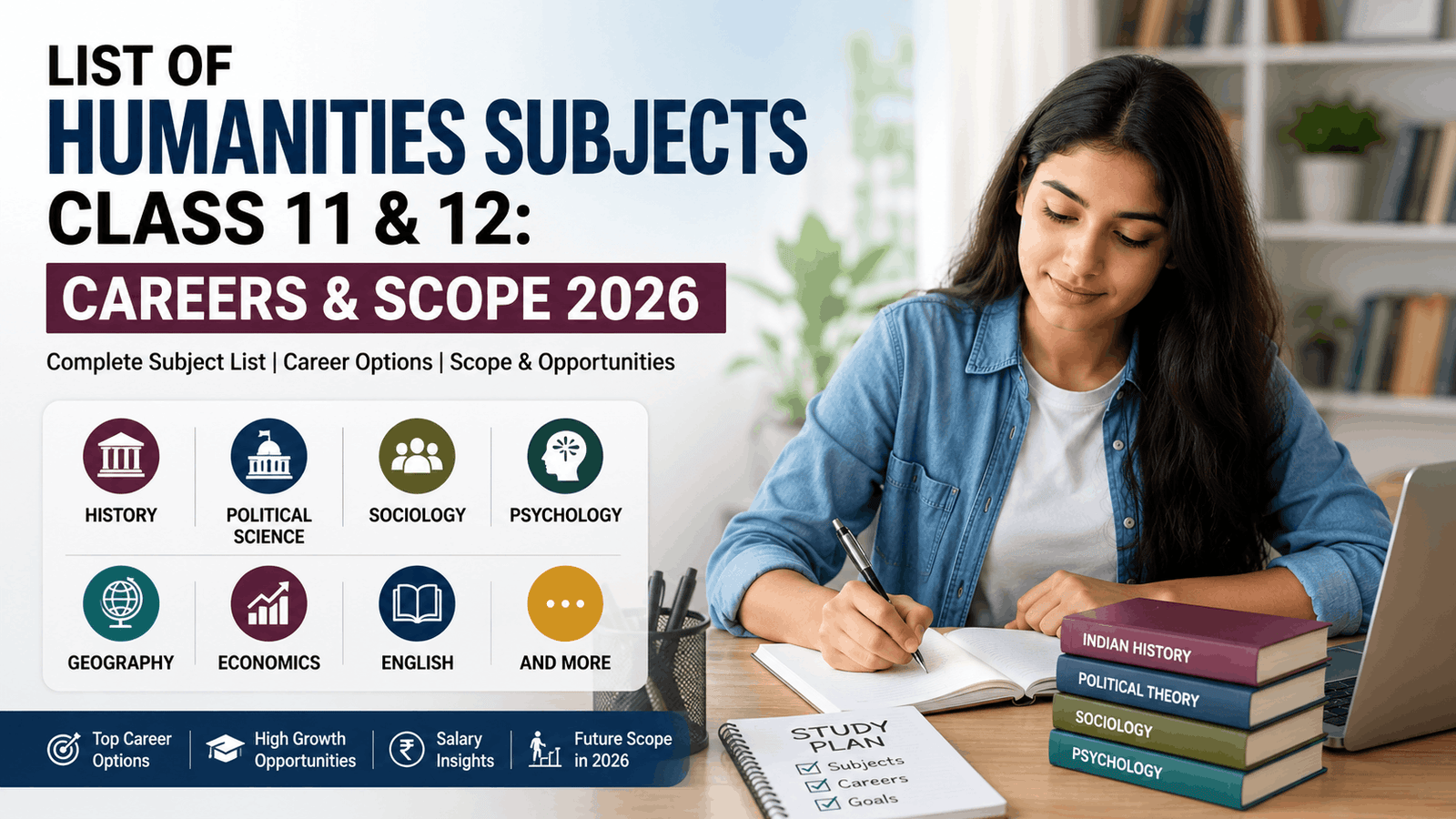

Humanities subjects prepare students for some of the most intellectually demanding and socially impactful careers in India — civil services, law, journalism, psychology, social research, teaching, and policy work. The assumption that humanities is a backup choice for students who couldn’t take Science is both outdated and wrong.
India’s best-paid civil servants cleared UPSC with History and Political Science optionals. Many of India’s sharpest corporate lawyers studied BA LLB from an NLU after choosing Humanities in Class 11. Major newspaper editors, documentary filmmakers, and policy researchers all came through the humanities stream. The stream itself is not the limitation — what students do with it is.
This article covers the complete humanities subjects list for Class 11 and 12 under CBSE, the best subject combinations for different career goals, how to choose after 10th, and the realistic career and salary scope for humanities stream students in India in 2026.
Key Takeaways
- Humanities subjects in Class 11 and 12 include History, Political Science, Geography, Economics, Sociology, Psychology, Legal Studies, and multiple language and elective options.
- The best humanities subject combination for UPSC/IAS aspirants is History + Political Science + Geography + Economics. This combination covers four UPSC optional subjects.
- Humanities stream careers with the highest salary ceiling: IAS/IPS (government), Law (corporate and litigation), Journalism (media leadership), and Psychology (clinical and organisational).
- Humanities is not a lesser stream. Students who choose it with a clear career goal consistently outperform those who chose Science or Commerce by default.
- Salary figures for humanities-stream careers vary widely. Government salaries follow the 7th Pay Commission. Private sector figures are indicative — verify at official portals.
What Are Humanities Subjects?
Humanities subjects are academic disciplines that study human society, culture, history, language, and behaviour. In Indian secondary education (Class 11 and 12), the Humanities or Arts stream includes subjects like History, Political Science, Geography, Economics, Sociology, Psychology, Philosophy, and Fine Arts. These subjects develop analytical thinking, writing, research, and communication skills that are directly applicable to careers in civil services, law, journalism, education, and social science.
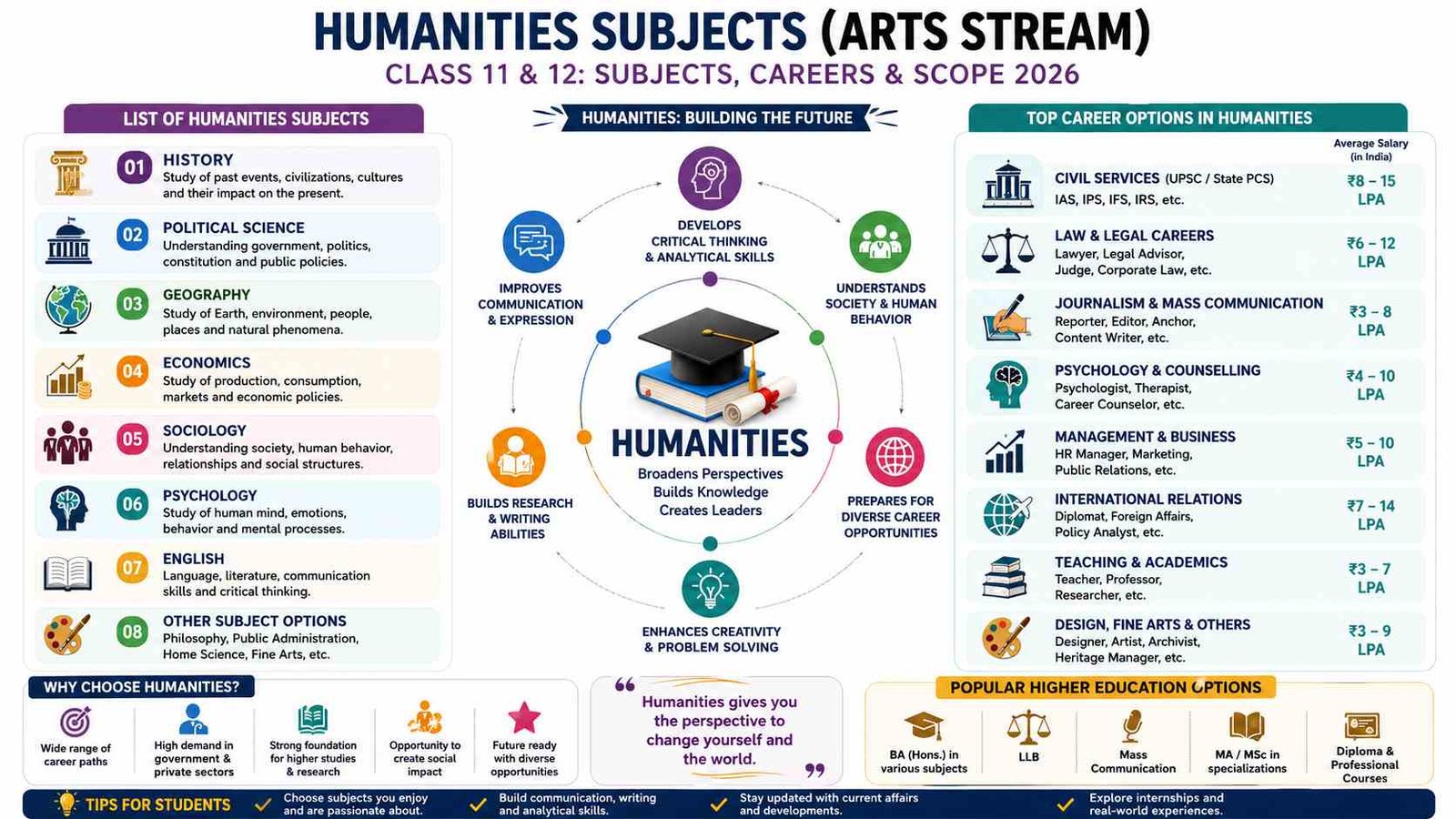
Complete Humanities Subjects List for Class 11 and 12 (CBSE 2026)
The CBSE humanities subjects list for Class 11 and 12 includes compulsory subjects and a range of elective options. Students typically choose five subjects — one language (compulsory), and four electives from the list below. Some schools allow a sixth subject. Check the current CBSE curriculum document for the latest approved subject codes.
For the official CBSE humanities subject list, codes, and syllabus updates, check the CBSE official website.
Core Compulsory Humanities Subjects (Class 11 and 12)
| Subject | Subject Code (CBSE) | Why It Matters | Career Connection |
| English Core | 301 | Compulsory for all streams | Communication, journalism, literature, content |
| Hindi Core / Elective | 002/302 | Language proficiency for Hindi medium aspirants | Civil services, teaching, media in Hindi belt |
| English Elective | 001 | Literature and advanced writing focus | Literature, academia, media, content writing |
| Hindi Elective | 002 | Advanced Hindi literature and linguistics | Teaching, journalism, literary careers |
Elective Humanities Subjects in Class 11 and 12
| Subject | Subject Code (CBSE) | Core Focus | Primary Career Path |
| History | 027 | Ancient, medieval, and modern history | UPSC/IAS, teaching, research, archaeology |
| Political Science | 028 | Government, constitution, international rel. | UPSC/IAS, law, journalism, diplomacy |
| Geography | 029 | Physical and human geography, cartography | UPSC/IAS, urban planning, GIS, teaching |
| Economics | 030 | Micro, macro, Indian economic development | Banking, UPSC, research, finance analytics |
| Sociology | 039 | Society, culture, social issues | Social work, HR, research, UPSC optional |
| Psychology | 037 | Human behaviour, mental processes | Counselling, HR, clinical practice, research |
| Philosophy | 024 | Ethics, logic, metaphysics | Civil services, law, academic research |
| Fine Arts (Painting) | 049 | Visual art, design, aesthetics | Design, animation, fine arts careers |
| Legal Studies | 042 | Constitution, law, rights | Law (pre-LLB), judicial exams, paralegal roles |
| Mass Media Studies | 066 | Media, communication, journalism basics | Journalism, broadcasting, digital media |
| Home Science | 064 | Nutrition, family resource management | Nutrition, healthcare, education |
| Physical Education | 048 | Sports science, fitness, health | Sports coaching, physiotherapy, armed forces |
| Informatics Practices | 065 | Basic IT, databases, networking | IT support, data entry, digital marketing support |
| Entrepreneurship | 066 | Business basics, startups | Business ownership, startup ecosystem |
| Dance | 070 | Classical and contemporary dance | Performing arts, choreography, teaching |
Best Subject Combinations in Humanities for Class 11 and 12
The best humanities subject combination depends entirely on your target career. There is no single best combination — the right one is the one that builds the strongest foundation for the career you are actually targeting. Choosing randomly or by what your friends are doing is one of the most common and most costly mistakes in this stream.
Best Humanities Subject Combination for UPSC and IAS
The best humanities subject combination for UPSC aspirants is History + Political Science + Geography + Economics. These four subjects directly overlap with UPSC Prelims General Studies and Mains GS papers. History and Political Science are the most popular UPSC optional subjects. Geography overlaps with GS Paper 1 and is another strong optional. Economics directly maps to GS Paper 3.
Check current UPSC CSE syllabus and optional subject requirements at the UPSC official website.
| Subject | UPSC Paper Overlap | Optional Subject? | Why This Combination Works |
| History | GS Paper 1, Mains | Yes — most popular optional | Ancient to modern India + world history in GS |
| Political Science | GS Paper 2 (Polity), Mains | Yes — Pol. Science & IR optional | Constitution, governance, international relations |
| Geography | GS Paper 1, Mains | Yes — strong optional | Physical + human + Indian geography in GS 1 |
| Economics | GS Paper 3 (Economy), Mains | Yes — Economics optional | Indian economy, development, agriculture in GS 3 |
For a deeper look at which UPSC subjects are the toughest and what preparation they need, read our guide on toughest exams in India.
Best Humanities Subject Combination for Journalism and Mass Media
For students targeting journalism, mass media, or digital content careers, the best combination is Political Science + History + Mass Media Studies + English (Elective). Political Science gives you the public affairs knowledge that drives most news. History builds research depth. Mass Media Studies at Class 11–12 level gives you the foundational framework. English Elective builds the writing precision you need professionally.
| Subject | Why It Matters | Career Outcome | Post-12th Course |
| Political Science | Public affairs, policy, government beats | Political journalist, policy reporter | BA Political Science or BJMC |
| English Elective | Writing precision, literary analysis | Editor, feature writer, long-form | BA English + PG Diploma Journalism |
| Mass Media Studies | Media basics, broadcasting, communication | Digital journalist, broadcaster | BJMC or BA Mass Communication |
| History | Research depth, context, narrative skill | Investigative journalist, documentary | BA History + media internship early |
Best Humanities Subject Combination for Law (BA LLB)
The best subject combination for students targeting law is Political Science + History + Legal Studies + Economics. Political Science directly underpins constitutional law. Legal Studies at Class 12 gives you foundational legal concepts. History builds case study and analytical reasoning skills. Economics is essential for commercial law, banking law, and corporate practice.
| Subject | Why It Matters for Law | Legal Specialisation | Post-12th Course |
| Political Science | Constitutional law, government powers, rights | Constitutional law, public law | BA LLB via CLAT or institutional entrance |
| Legal Studies | Foundational legal concepts, contracts, rights | All legal specialisations | Head start on 1st year LLB concepts |
| History | Historical legal cases, analytical reasoning | Criminal law, historical interpretation | Research and mooting competitions |
| Economics | Commercial transactions, market regulation | Corporate law, banking, tax law | Commerce law, SEBI cases, M&A work |
Best Humanities Subject Combination for Psychology and Social Work
For students targeting psychology, counselling, or social work, the best combination is Psychology + Sociology + Economics + English Elective. Psychology at Class 12 gives a direct head start for BA/B.Sc Psychology entrance preparation. Sociology builds the social context understanding that clinical and counselling practice requires. Economics is useful for Industrial and Organisational Psychology careers.
For a dedicated guide to psychology courses after 12th including career paths and salary, read our guide on psychology courses after 12th in India.
| Subject | Why It Matters | Career Outcome | Post-12th Course |
| Psychology | Direct subject overlap with BA/B.Sc Psychology | Clinical, counselling, I/O Psychology | BA/B.Sc Psychology from any recognised univ. |
| Sociology | Social context for counselling and research | Social work, HR, community mental health | MSW after BA Sociology + Psychology |
| Economics | Workplace behaviour, I/O psychology base | I/O Psychology, HR analytics | MA Psychology (I/O specialisation) |
| English | Client communication, report writing | Private practice, corporate counselling | Needed for research papers and assessments |
Humanities Subjects After 10th in 2026
Choosing humanities subjects after 10th is the right decision for a student who is drawn to reading, writing, history, current affairs, social issues, or language — rather than someone who is avoiding Science because Maths was hard. The second reason leads to poor subject engagement, poor board scores, and poor career outcomes. The first reason leads to genuine expertise.
A student from Jaipur who had scored 78% in Class 10 chose Humanities specifically because he read the newspaper every morning and found political debates genuinely interesting. He chose History + Political Science + Geography + Economics. He cleared UPSC CSE at 24 on his second attempt. His Class 10 marks were average. His subject engagement was exceptional. That pattern repeats more than people realise.
| If You Are Drawn To… | Stream to Choose | Key Class 11-12 Subjects | Degree After 12th |
| History, politics, public affairs | Humanities | History + Pol. Science + Geography | BA + UPSC, BA LLB, BA Political Science |
| Writing, language, literature | Humanities | English Elective + History + Sociology | BA English, BJMC, BA Journalism |
| Human behaviour, society, mind | Humanities | Psychology + Sociology + Economics | BA/B.Sc Psychology, MSW |
| Business, numbers, markets | Commerce | Accountancy + Economics + Business | B.Com, CA, BBA, MBA |
| Maths, physics, engineering | Science | PCM | B.Tech, B.Sc, NEET (PCB) |
| Biology, medicine, healthcare | Science | PCB | MBBS, NEET, B.Sc Nursing |
Students after 10th comparing all available streams and career paths can read our guide on career options after 10th in India.
Humanities Subjects With Highest Salary in 2026
Humanities subjects with the highest salary career outcomes are those that combine with professional degrees, government service, or highly specialised practice. The raw humanities degree is not what drives salary — it is what that degree leads to and what the professional does with it.
The highest-paying humanities-stream careers in India are: IAS/IPS through UPSC (government pay + allowances), corporate law (LLB from NLU + corporate law firm), journalism leadership (media company editorial head), organisational psychology (HR or consulting at MNCs), and economics research (RBI, NABARD, policy institutions).
| Humanities Career | Subjects in Class 12 | Post-12th Degree | Pay Reference |
| IAS / IPS (UPSC CSE) | History, Pol. Science, Geography, Economics | BA + UPSC CSE | 7th CPC Level 10+; verify at upsc.gov.in |
| Corporate Lawyer (NLU) | Political Science, Legal Studies, History | BA LLB via CLAT | Varies; top NLU grads at top law firms earn competitively |
| Economist / Policy Researcher | Economics, Political Science, Sociology | BA Economics + MA/PhD | RBI, NABARD; verify at respective official portal |
| Clinical Psychologist | Psychology, Sociology, Economics | BA/BSc + MA/MSc + MPhil | Per RCI-regulated institutions; verify at rehabcouncil.nic.in |
| Journalist / Media Editor | Political Science, History, Mass Media | BA + PG Diploma / BJMC | Varies widely; leadership roles at national media competitively |
| UGC NET Professor | Any humanities optional subject | MA + NET + PhD (preferred) | 7th CPC Academic Pay Level; verify at ugc.ac.in |
| IFS (Indian Foreign Service) | History, Pol. Science, International Rel. | BA + UPSC CSE | 7th CPC + foreign allowances; verify at upsc.gov.in |
| Social Entrepreneur / NGO Head | Sociology, Economics, Geography | BA + MBA Social Ent. or MSW | Varies; funded NGOs pay market rates to leadership |
Government salaries are based on the 7th Pay Commission. Private sector, legal, and media salaries are not standardised. Verify all pay figures at official government portals or verified company career pages before making financial decisions.
Best Humanities Subjects for IAS and UPSC
Humanities subjects for IAS are among the most discussed topics in the UPSC preparation community. The consensus among successful candidates is clear: History and Political Science give the broadest overlap with GS papers, making them the most efficient subject choices for aspiring IAS officers. Geography is the most popular optional among toppers for its visual, map-based learning style.
| UPSC Optional Subject | Class 12 Subject Overlap | Difficulty Level | Why Toppers Choose It |
| History | Direct overlap with Class 12 History | High volume; strong readers do well | Most chosen humanities optional; wide toppers list |
| Political Science & IR | Overlaps with Class 12 Pol. Sc. significantly | Analytical writing heavy | IFS aspirants prefer this; foreign policy heavy |
| Geography | Overlaps with Class 12 Geography directly | Map-based; visual learners benefit | Most popular optional among UPSC toppers |
| Economics | Overlaps with Class 12 Economics partially | Conceptual; strong Maths basis helps | Used with UPSC Mains GS Paper 3 overlap |
| Sociology | Overlaps with Class 12 Sociology | Essay-heavy; concise writing rewarded | Good for GS Paper 1 + Essay overlap |
| Philosophy | Limited Class 12 overlap unless studied | Conceptual; logic-heavy | Smaller coaching ecosystem; self-study needed |
| Public Administration | No direct Class 12 subject; studied fresh | Current affairs heavy | Combined well with Political Science background |
For a full overview of which UPSC exams are the toughest and what preparation they demand, read our guide on toughest exams in India 2026.
Best Humanities Subjects for Girls
Humanities subjects are among the best subject choices for girls who want a stable, respected, and career-strong path after 12th. Civil services, law, journalism, teaching, psychology, and social work are all fields with strong female professional representation, transparent career ladders, and — in the case of government roles — completely gender-neutral pay scales.
Female students exploring all career options from humanities and beyond can read our guide on best career options for girls in India.
| Career Goal | Best Subjects in Class 12 | Why It Suits | Post-12th Path |
| IAS / Civil Services | History + Pol. Sc. + Geography + Economics | Transparent merit-based selection; no gender bias | BA + UPSC prep; 6 attempts for General category |
| Law (BA LLB) | Pol. Sc. + Legal Studies + History | Strong female representation at NLUs | BA LLB via CLAT; high NLU female enrolment |
| School Teaching + NET | Any humanities combination + Education | Structured hours; govt. pay; local posting possible | BA + MA + UGC NET; stable career near home |
| Psychology / Counselling | Psychology + Sociology + Economics | Strong female professional base in counselling | BA/B.Sc Psychology + MA + MPhil for clinical |
| Journalism / Digital Media | Pol. Sc. + English Elective + Mass Media | Digital journalism enables remote working | BJMC or BA + PG Diploma in Journalism |
| Social Work / NGO | Sociology + Economics + Psychology | Mission-driven; structured career ladder in NGOs | BA + MSW; TISS is the top institution |
| HR / Organisational Psych. | Psychology + Economics + Sociology | Corporate HR; strong female representation | BA Psych + MA Psych (I/O) or MBA HR |
| Foreign Service (IFS) | History + Pol. Sc. + International Rel. | Gender-neutral UPSC selection | BA + UPSC CSE; IFS cadre has growing female intake |
Humanities Stream Career Options and Salary Scope in India 2026
Humanities stream career options are wider than the standard ‘teacher, journalist, or IAS’ framing that most families use. The stream produces civil servants, corporate lawyers, foreign policy analysts, clinical psychologists, economists, policy researchers, urban planners, museum curators, documentary filmmakers, and data journalists. The career scope is genuinely broad.
For a complete list of all career options available to humanities stream students after 12th, read our guide on career options for Arts and Humanities students after 12th.
| Career | Entry Qualification | Key Humanities Subjects | Pay Level Reference |
| IAS / IPS (Civil Services) | BA + UPSC CSE | History, Pol. Sc., Geography, Economics | 7th CPC Level 10+; verify at upsc.gov.in |
| Corporate Lawyer | BA LLB (NLU via CLAT) | Pol. Sc., Legal Studies, History | Market rates; top NLU placements vary; verify at firms |
| Journalist / Editor | BJMC / BA + PG Diploma | Pol. Sc., English, Mass Media | Varies by media org; leadership roles competitively |
| Clinical Psychologist | BA + MA + MPhil (RCI) | Psychology, Sociology | RCI-regulated; verify at rehabcouncil.nic.in |
| Economist / Analyst | BA Economics + MA or MBA | Economics, Political Science | RBI, NABARD; verify at respective official portals |
| UGC NET Professor | MA + UGC NET + PhD (pref.) | Any humanities subject | 7th CPC Academic Pay Level; verify at ugc.ac.in |
| Social Worker (MSW) | BA + MSW | Sociology, Psychology, Economics | NGO/Govt; varies by employer and sector |
| HR Manager / I/O Psychologist | BA Psych + MA + MBA HR | Psychology, Sociology, Economics | Corporate; verify at company career portals |
| Urban Planner / Geographer | BA Geography + MA/M.Plan | Geography, Economics | Govt development agencies; verify at specific portals |
| Documentary Filmmaker | BA + FTII/NID/private course | Mass Media, History, Sociology | Varies widely; OTT and public media commission work |
All salary figures for humanities careers in the private sector are not standardised. Government salaries follow the 7th Pay Commission or UGC pay scales. Always verify current pay at the relevant official portal before making financial plans.
How to Choose Humanities Subjects in Class 11
- Start with your career goal, not your subject preference. Most students choose subjects first and figure out careers later. Reverse this. Identify even a rough career direction — law, IAS, journalism, psychology — and work backward to the subjects that serve it best.
- Cross-check your chosen subjects against the entrance exam requirements for your target degree programme. CLAT for BA LLB requires no specific 12th subjects, but Political Science gives you a head start. UPSC benefits from History + Pol. Sc. + Geography. Know this before you finalise your combination.
- Check whether your school actually offers your preferred subject combination. Subjects like Legal Studies, Mass Media Studies, and Philosophy are not available at all schools. If your first-choice school doesn’t offer your ideal combination, factor that into your school selection.
- Do not pick subjects based on what’s considered ‘easy to score in’. In CBSE board exams, the scaling and marking patterns mean that ‘easier’ subjects often have tighter marking. Pick subjects where you will stay engaged through two full years of study.
For personalised guidance on which humanities subjects and career path fit your interests, explore our career counselling for 12th students page.
Final Thoughts
They treat the humanities stream as a default for students who didn’t qualify for Science or couldn’t handle Commerce Maths. That framing produces disengaged students and poor outcomes. The students who build remarkable careers from humanities are the ones who chose it because they actually found politics, history, psychology, or social science genuinely interesting — not the ones who settled for it.
For students in Tier 2 and Tier 3 cities: the UPSC selection process has a completely flat playing field. The same paper, the same exam, the same merit list applies to a student from Sitamarhi and one from South Delhi. History, Political Science, and Geography — the core humanities subjects — are the foundation of that exam. If your city has limited career options, UPSC is one of the most powerful tools for mobility that exists in India, and humanities is its natural academic feeder.
Choose your humanities subjects based on your career goal. Start reading about that career from Class 11 itself — not just studying for boards. By the time you reach 12th, you will have two years of genuine engagement with the field, and that separates you from every student who only started thinking about their career after their board results.
FAQs
Humanities subjects in Class 11 and 12 include History, Political Science, Geography, Economics, Sociology, Psychology, Philosophy, Legal Studies, Mass Media Studies, Fine Arts, and language options. Students typically choose five subjects: one compulsory language and four electives. Verify current subject availability at your school and at the CBSE official website.
The best humanities subjects for UPSC are History, Political Science, Geography, and Economics. These four subjects directly overlap with UPSC Prelims GS and Mains GS papers. History and Political Science are the most popular UPSC optional subjects. Geography is the most popular optional among toppers. All four together give the broadest UPSC preparation advantage.
Career options after humanities subjects include IAS/IPS (UPSC CSE), corporate and litigation law (BA LLB via CLAT), journalism and mass media, clinical and organisational psychology, economics and policy research, UGC NET teaching, social work, urban planning, HR management, and documentary filmmaking. The career scope is significantly broader than most families assume.
History + Political Science + Geography + Economics leads to UPSC Civil Services — the highest-salary government career. For private sector, Political Science + Legal Studies + History leads to law (BA LLB via NLU), which offers competitive corporate law salaries. Salary in both cases depends significantly on effort post-12th, not just subject choice in school.
The best combination depends on your career goal. For UPSC/IAS: History + Political Science + Geography + Economics. For law: Political Science + Legal Studies + History + English Elective. For journalism: Political Science + English Elective + History + Mass Media Studies. For psychology: Psychology + Sociology + Economics + English Elective.